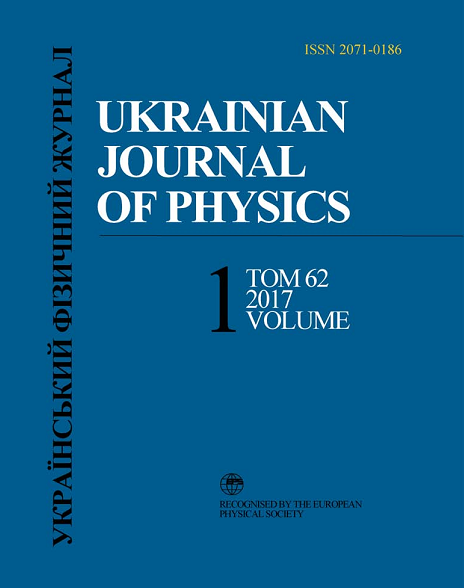
On Some Important Results in Semiconductor Surface Science Obtained in Ukraine During the Independence Years (1991–2016)
DOI:
https://doi.org/10.15407/ujpe62.01.0080Keywords:
semiconductor surface science, physics of real semiconductor surface, physics of metal–semiconductor interface, physics of atomically clean surface, physics of surface-sensitive semiconductor sensorsAbstract
Some important results obtained by Ukrainian physicists in semiconductor surface science during the independence years (1991–2016) are discussed. The review is mainly focused on the results obtained for nano-dimensional and quantum-size structures and classifies them according to the main scientific directions in the modern Ukrainian semiconductor surface science.
References
V. Litovchenko, A. Evtukh. Vacuum nanoelectronic. In Handbook of Semiconductor Nanostructures and Nanodevices, edited by A.A. Balandin, K.L. Wang (American Scientific Publishers, 2006).
V. Litovchenko, A. Grygoriev, A. Evtukh, O. Yilmazoglu, H.L. Hartnagel, D. Pavlidis. Electron field emission from wide bandgap semiconductors under intervalley carrier redistribution. J. Appl. Phys. 106, 104511 (2009) .
https://doi.org/10.1063/1.3259384
A. Evtukh, A. Grygoriev, V. Litovchenko, O. Steblova, O. Yilmazoglu, H.L. Hartnagel, H. Mimura. Influence of the emitted electron energy distribution from nanocathodes upon the current-voltage characteristic. J. Vac. Sci. Technol. B 32, 02B104 (2014) .
V.G. Litovchenko, D.V. Korbutyak, Yu.V. Kryuchenko et al. Polarization phenomena in 2D structures with quantum wells. Phys. Low-Dim. Struct. No. 10/11, 187 (1995).
D.V. Korbutyak, S.G. Krylyuk, V.G. Litovchenko et al. Analysis of photoluminescence spectra peculiarities of short-period GaAs/AlAs superlattices. Phys. Low-Dim. Struct. No. 11/12, 97 (1996).
V.G. Litovchenko, D.V. Korbutyak, S.G. Krylyuk et al. Enhancement of electron-phonon interaction in ultrashortperiod GaAs/AlAs superlattices. Phys. Rev. B 55, 10621 (1997) .
https://doi.org/10.1103/PhysRevB.55.10621
D.V. Korbutyak, S.G. Krylyuk, V.G. Litovchenko et al. Photoluminecsence kinetics in quantum superlattices of kinds I and II. Ukr. Fiz. Zh. 43, 124 (1998) (in Ukrainian).
A.P. Oksanych, V.A.Terban, S.O. Volokhov, M.I. Klyui, V.A. Skryshevsky, V.P. Kostylyov, A.V. Makarov. Modern production technologies of silicon and silicon-based photo-electric converters of solar energy (Mineral, 2010) (in Ukrainian) [ISBN 978-966-7830-IS-0].
A.P. Gorban', V.P. Kostylyov, V.N. Borschev, A.M. Listratenko. Prospects for development of silicon photoconverters and batteries for space use. Telecommun. Radio Eng. 55, 94 (2001) .
https://doi.org/10.1615/TelecomRadEng.v55.i9.120
V.A. Semenovich, N.I. Klyui, V.P. Kostylyov, V.G. Litovchenko, V.V. Chernenko. Compositional modulated DLC films for improvement of solar cells efficiency and radiation stability. J. Chem. Vapor Deposit. 5, 213 (1997).
A.V. Sachenko, A.P. Gorban, V.P. Kostylyov, A.A. Serba, I.O. Sokolovskyi. Comparative analysis of photoconversion efficiency in the Si solar cells under concentrated illumination for the standard and rear geometries of arrangement of contacts. Semiconductors 41, 1214 (2007).
https://doi.org/10.1134/S106378260710017X
A.V. Sachenko, Yu.V. Kryuchenko, V.P. Kostylyov, A.V. Bobyl, E.I. Terukov, S.N. Abolmasov, A.S. Abramov, D.A. Andronikov, M.Z. Shvarts, I.O. Sokolovskyi, M. Evstigneev. Temperature dependence of photoconversion efficiency in silicon heterojunction solar cells: Theory vs experiment. J. Appl. Phys. 119, 225702 (2016) [DOI: 10.1063/1.4953384].
https://doi.org/10.1063/1.4953384
A.V. Sachenko, A.I. Shkrebtii, R.M. Korkishko, V.P. Kostylyov, M.R. Kulish, I.O. Sokolovskyi, M. Evstigneev. Analysis of the attainable efficiency of a direct-bandgap betavoltaic element. J. Phys. D 48, 455101 (2015).
https://doi.org/10.1088/0022-3727/48/45/455101
V.G. Litovchenko, V.P. Melnik, B.M. Romanyuk, B.F. Dvernikov, R.M. Korkishko, V.P. Kostylyov, S.M. Musaev, V.G. Popov, V.V. Chernenko. Mobile solar power stations for use in the field. Visn. Nats. Akad. Nauk Ukr. No. 11, 59 (2015) (in Ukrainian).
https://doi.org/10.15407/visn2015.11.059
R.M. Korkishko, B.N. Romanyuk, V.P. Melnyk, V.P. Kostylyov. Mobile device for feeding and charging low-power equipment under field conditions. Patent of Ukraine No. 105847 for useful model. Registered on 04.11.2016 (in Ukrainian).
V.G. Litovchenko, T.I. Gorbanyuk, V.S. Solntsev, A.A. Evtukh. Mechanism of hydrogen, oxygen and humidity sensing by Cu/Pd-porous silicon–silicon structures. Appl. Surf. Sci. 234, 262 (2004).
https://doi.org/10.1016/j.apsusc.2004.05.146
V.G. Litovchenko, T.I. Gorbanyuk, V.S. Solntsev. New adsorption active nanoclusters for ecological monitoring. In Nanodevices and Nanomaterials for Ecological Security (Springer, 2012), p. 297.
https://doi.org/10.1007/978-94-007-4119-5_27
I.P. Lisovskyi, V.G. Litovchenko, I.Z. Indutnyi, D.O. Mazunov, P.E. Shepelyavyi. Infrared study of thermally induced phase separation in SiO films. Ukr. J. Phys. 50, 249 (2005).
A.M. Nyamsi Hendji, N. Jaffrezic-Renault, C. Martelet, P. Clechet, A.A. Shlu'ga, V.I. Strikha, L.I. Netchiporuk, A.P. Soldatkin, W.B. Wlodarski. Sensitive detection of pesticides using a differential ISFET-based system with immobilized cholinesterases. Anal. Chim. Acta 281, 3 (1993) [DOI: 10.1016/0003-2670(93)85333-F].
https://doi.org/10.1016/0003-2670(93)85333-F
V.A. Vikulov, V.I. Strikha, V.A. Skryshevsky, S.S. Kilchitskaya, E. Souteyrand, J.-R. Martin. Electrical features of the metal-thin porous silicon-silicon structure. J. Phys. D 33, 1957 (2000) .
https://doi.org/10.1088/0022-3727/33/16/304
A.I. Manilov, V.A. Skryshevsky. Hydrogen in porous silicon – A review. Mater. Sci. Eng. B 178, 942 (2013).
https://doi.org/10.1016/j.mseb.2013.05.001
O.L. Syshchyk, V.A. Skryshevsky, O.O. Soldatkin, A.P. Soldatkin. Enzyme biosensor systems based on porous silicon photoluminescence for detection of glucose, urea and heavy metals. Biosens. Bioelectron. 66, 89 (2015).
https://doi.org/10.1016/j.bios.2014.10.075
V.A. Skryshevsky, O.V. Tretiak, V.A. Vikulov, V.M. Zinchuk, F. Koch, Th. Dittrich. Electrical characterization of gas sensing devices based on porous TiO2. Phys. Status Solidi A 197, 534 (2003) .
https://doi.org/10.1002/pssa.200306559
V.A. Skryshevsky, Yu. S. Milovanov, I.V. Gavrilchenko, S.I. Tiagulskyi, A.V. Rusavsky, V.S. Lysenko, A.N. Nazarov. Impedance spectroscopy of single graphene layer at gas adsorption. Phys. Status Solidi A 212, 1941 (2015).
https://doi.org/10.1002/pssa.201532101
S. Litvinenko, D. Bielobrov, V. Lysenko, T. Nychyporuk, V. Skryshevsky. Might silicon surface be used for electronic tongue application? ACS Appl. Mater. Interfac. 6, 18440 (2014).
https://doi.org/10.1021/am5058162
V.A. Skryshevsky, A. Laugier, V.I. Strikha, V.A. Vikulov. Evaluation of quantum efficiency of porous silicon photoluminescence. Mat. Sci. Eng. B 40, 54 (1996).
https://doi.org/10.1016/0921-5107(96)01572-3
O. Nichiporuk, A. Kaminski, M. Lemiti, A. Fave, S. Litvinenko, V. Skryshevsky. Passivation of the surface of rear contact solar cells by porous silicon. Thin Solid Films 512, 248 (2006) .
https://doi.org/10.1016/j.tsf.2005.12.053
I.I. Ivanov, V.A. Skryshevsky, T. Nychyporuk, M. Lemiti, A.V. Makarov, N.I. Klyui, O.V. Tretyak. Porous silicon Bragg mirrors on single- and multi-crystalline silicon for solar cells. Renew. Ener. 55, 79 (2013).
https://doi.org/10.1016/j.renene.2012.12.031
Method for the research of the surface structure of noncrystalline solids. Patent No. 3917426 (1987) (in Russian).
O. Bondarchuck, S. Goysa, I. Koval, P. Mel'nik, M. Nakhodkin. Short-range order of disordered solid surfaces from elastically scattered electron spectra. Surf. Rev. Lett. 04, 965 (1997).
https://doi.org/10.1142/S0218625X97001139
O. Bondarchuk, S. Goysa, I. Koval, P. Melnik, M. Nakhodkin. On the short-range order of the SiO (0 2) surface. Appl. Surf. Sci. 255, 6421 (2009)
https://doi.org/10.1016/j.apsusc.2009.02.031
Ionization Spectroscopy. Edited by M. Nakhodkin (Lybid', 1992) (in Ukrainian).
http://www.is.univ.kiev.ua/Software/nSpView.html.
S.Yu. Bulavenko, I.F. Koval, P.V. Melnik, N.G. Nakhodkin, H.J.W. Zandvliet. STM investigation of the initial adsorption stage of Bi on Si(1 0 0)-(2×1) and Ge(1 0 0)-(2×1) surfaces. Surf. Sci. 482–485, 370 (2001)].
https://doi.org/10.1016/S0039-6028(01)00804-4
A. Goryachko, P.V. Melnik, N.G. Nakhodkin, T.V. Afanasjeva, I.F. Koval. New features of the Si(1 0 0)-c(44) reconstruction observed with STM: suggestion of the structure with lowered symmetry. Surf. Sci. 497, 47 (2002)].
https://doi.org/10.1016/S0039-6028(01)01623-5
S.Yu. Bulavenko, I.F. Koval, P.V. Melnik, N.G. Nakhodkin. The concerted movements of weakly bonded Bi dimers on the Si(1 0 0)21 surface. Surf. Sci. 507–510, 119 (2002) .
https://doi.org/10.1016/S0039-6028(02)01186-X
S.Yu. Bulavenko, P.V. Melnik, M.G. Nakhodkin. Scanning tunneling microscopy images of the atoms in the corner holes on the Si(1 1 1)-(77) surface with bismuth-covered tips. Surf. Sci. 469, 127 (2000) .
https://doi.org/10.1016/S0039-6028(00)00798-6
S.Yu. Bulavenko, P.V. Melnik, M.G. Nakhodkin, A. Goriachko. Investigation of hydrogen interaction with the Si(1 1 1)-(77) surface by STM with Bi/W tips. Surf. Sci. 600, 1185 (2006) .
https://doi.org/10.1016/j.susc.2006.01.021
I.F. Koval, P.V. Melnik, N.G. Nakhodkin, M.Yu. Pyatnitsky, T.V. Afanasieva. Interaction of O2 with the BiSi(001) system: from passivation to promoted oxidation. Surf. Sci. 384, L844 (1997).
https://doi.org/10.1016/S0039-6028(97)00285-9
T.V. Afanasieva, S.Yu. Bulavenko, I.F. Koval, H.J.W. Zandvliet. Diffusion of Si and Ge dimers on Ge(001) surfaces. J. Appl. Phys. 93, 1452 (2003).
https://doi.org/10.1063/1.1533107
I.P. Koval, Y.A. Len, M.G. Nakhodkin, M.O. Svishevs'kyi, M.Y. Yakovenko. Interaction of molecular oxygen with Si(001) surface covered with a chromium or titanium monolayer. Ukr. J. Phys. 60, 46 (2015) .
https://doi.org/10.15407/ujpe60.01.0046
M.G. Nakhodkin, M.I. Fedorchenko, Adsorption of Bi atoms on Ge(111)-c(2 8) surface. Visn. Nats. Akad. Nauk Ukr. Ser. Fiz. Mat. Nauky No. 4, 236 (2010) (in Ukrainian).
M.Yu. Pyatnitskii, I.F. Koval', P.V. Mel'nik, N.G. Nakhodkin, T.V. Afanas'eva. Effects of adsorbed bismuth on Si(001) surface electronic states. Theor. Exp. Chem. 32, No. 3, 148 (1996).
https://doi.org/10.1007/BF01373240
T.V. Afanasieva. Adsorption and dynamics of group IV, V atoms and molecular oxygen on semiconductor group IV (0 0 1) surfaces. J. Phys.: Condens. Matter 28, 313001 (2016).
https://doi.org/10.1088/0953-8984/28/31/313001
N.G. Nakhodkin, T.V. Rodionova. The mechanism of secondary grain growth in polysilicon films. J. Cryst. Growth 171, 50 (1997)
https://doi.org/10.1016/S0022-0248(96)00476-9
N.G. Nakhodkin, N.P. Kulish, T.V. Rodionova. Faceting of twin tips in polysilicon films. J. Cryst. Growth 381, 65 (2013).
https://doi.org/10.1016/j.jcrysgro.2013.06.029
N.G. Nakhodkin, N.P. Kulish, P.M. Lytvyn, T.V. Rodionova. Features of special joints of grain boundaries in polysilicon films of equiaxial and dendritic structures. Funct. Mater. 13, 305 (2006).
M.G. Nakhodkin, M.I. Fedorchenko. Interaction of oxygen and gadolinium with Si(100)-2 1 surface. Formation of a system with 1-eV work function. Ukr. J. Phys. 60, 97 (2015) ].
https://doi.org/10.15407/ujpe60.02.0097
Faculty of Physics of I.I. Mechnikov National University of Odesa. 1865–2000: Collection of papers. Edited by G.G. Chemeresyuk (Astroprint, 2001) (in Ukrainian).
V.A. Smyntyna. Molecular Electron Phenomena on the Semiconductor Surface: Selenide and Cadmium Sulfide Films (Astroprint, 2008) (in Russian).
V.A. Smyntyna. Molecular Electron Phenomena on the Semiconductor Surface: Semiconductor Gas Sensors (Astroprint, 2009) (in Russian).
I.R. Yatsunskii, O.A. Kulinich, V.A. Smyntyna. Influence of Oxidation on Defect Formation in Doped Silicon (Lambert, 2011) (in Russian) [ISBN: 978-3-8465-4157-9]. A.A. Karpenko. Nonperfect heterojunctions for image sensors (Odesa National University, 2014) (in Russian).
Nonequilibrium Processes in Sensor Nanostructures. Edited by V.A. Smyntyna. (Odesa National University, 2015) (in Russian).
V. Smyntyna. Electron and Molecular Phenomena on the Surface of Semiconductors (Nova Publishers, 2013).
V. Smyntyna. Semiconductor Materials for Gas Sensors (Nova Publishers, 2013).
V. Smyntyna, A. Tereshchenko. Metal oxide based biosensors for the detection of dangerous biological compounds? In Nanomaterials for Security. Edited by J. Bon˘ca, S. Kruchinin (Springer, 2016), p. 281.
V.A. Smyntyna. Physical and Chemical Phenomena on Solid Surface (Astroprint, 2009) (in Ukrainian).
V.A. Smyntyna. Course of General Physics (Astroprint, 2012) (in Ukrainian).
V.A. Smyntyna. Surface Phenomena in Semiconductors (Odesa National University, 2016) (in Ukrainian).
R. Viter, I. Baleviciute, A. Abou Chaaya, L. Mikoliunaite, Z. Balevicius, A. Ramanavicius, A. Zalesska, V. Vataman, V. Smyntyna, Z. Gertnere, D. Erts, P. Miele, M. Bechelany. Optical properties of ultrathin Al2O3/ZnO nanolaminates. Thin Solid Films 594, 96 (2015) .
https://doi.org/10.1016/j.tsf.2015.10.018
I. Iatsunskyi, M. Jancelewicza, G. Nowaczyka, M. Kempi’nskia,B. Pepli’nskaa,M. Jareka, K. Za le˛skia, S. Jurga, V. Smyntyna. Atomic layer deposition TiO2 coated porous silicon surface: Structural characterization and morphological features. Thin Solid Films 594, 303 (2015).
https://doi.org/10.1016/j.tsf.2015.05.056
R. Viter, Z. Balevicius, A. Abou Chaaya, I. Baleviciute, S. Tumenas, L. Mikoliunaite, A. Ramanavicius, Z. Gertnere, A. Zalesska, V. Vataman, V. Smyntyna, D. Erts, P. Miele, M. Bechelany. The influence of localized plasmons on the optical properties of Au/ZnO nanostructures. J. Mater. Chem. C 3, 6815 (2015) [DOI: 10.1039/c5tc00964b].
https://doi.org/10.1039/C5TC00964B
I. Iatsunskyi, M. Pavlenko, R. Viter, M. Jancelewicz, G. Nowaczyk, I. Baleviciute, K. Zaleski, S. Jurga, A. Ramanavicius, V. Smyntyna. Tailoring the structural, optical, and photoluminescence properties of porous silicon/TiO2 nanostructures. J. Phys. Chem. C 119, 7164 (2015) [DOI: 10.1021/acs.jpcc.5b01670].
https://doi.org/10.1021/acs.jpcc.5b01670
I. Iatsunskyi, M. Kempinski, M. Jancelewicz, K. Zaleski, S. Jurga, V. Smyntyna. Structural and XPS characterization of ALD Al2O3 coated porous silicon. Vacuum 113, 52 (2015).
https://doi.org/10.1016/j.vacuum.2014.12.015
R. Viter, A. Abou Chaaya, I. Iatsunskyi, G. Nowaczyk, K. Kovalevskis, D. Erts, P. Miele, V. Smyntyna, M. Bechelany. Tuning of ZnO 1D nanostructures by atomic layer deposition and electrospinning for optical gas sensor applications. Nanotechnology 26, 105501 (2015) .
https://doi.org/10.1088/0957-4484/26/10/105501
V. Smyntyna. The chemisorption forms and the centre nature of oxigen chemisorption on the CdSe thin-film surfaces. Nuovo Cimento 63B, 642 (1981).
https://doi.org/10.1007/BF02755104
Ya.I. Lepikh, I.A. Ivanchenko, L.M. Budiyaskaya. Uncooled p(Pb1−SnSe)–n(CdSe) hetero-structure-based spectral range. Semicond. Phys. Quant. Electron. Optoelectron. 17, 408 (2014).
https://doi.org/10.15407/spqeo17.04.408
Ya.I. Lepikh, I.A. Ivanchenko, L.M. Budiyaskaya. Stripline-type photodetector based on the narrow-gap ternary compound Hg1−CdTe for the far IR region. J. Eng. Phys. Thermophys. 86, 242 (2013).
Downloads
Published
Issue
Section
License
Copyright Agreement
License to Publish the Paper
Kyiv, Ukraine
The corresponding author and the co-authors (hereon referred to as the Author(s)) of the paper being submitted to the Ukrainian Journal of Physics (hereon referred to as the Paper) from one side and the Bogolyubov Institute for Theoretical Physics, National Academy of Sciences of Ukraine, represented by its Director (hereon referred to as the Publisher) from the other side have come to the following Agreement:
1. Subject of the Agreement.
The Author(s) grant(s) the Publisher the free non-exclusive right to use the Paper (of scientific, technical, or any other content) according to the terms and conditions defined by this Agreement.
2. The ways of using the Paper.
2.1. The Author(s) grant(s) the Publisher the right to use the Paper as follows.
2.1.1. To publish the Paper in the Ukrainian Journal of Physics (hereon referred to as the Journal) in original language and translated into English (the copy of the Paper approved by the Author(s) and the Publisher and accepted for publication is a constitutive part of this License Agreement).
2.1.2. To edit, adapt, and correct the Paper by approval of the Author(s).
2.1.3. To translate the Paper in the case when the Paper is written in a language different from that adopted in the Journal.
2.2. If the Author(s) has(ve) an intent to use the Paper in any other way, e.g., to publish the translated version of the Paper (except for the case defined by Section 2.1.3 of this Agreement), to post the full Paper or any its part on the web, to publish the Paper in any other editions, to include the Paper or any its part in other collections, anthologies, encyclopaedias, etc., the Author(s) should get a written permission from the Publisher.
3. License territory.
The Author(s) grant(s) the Publisher the right to use the Paper as regulated by sections 2.1.1–2.1.3 of this Agreement on the territory of Ukraine and to distribute the Paper as indispensable part of the Journal on the territory of Ukraine and other countries by means of subscription, sales, and free transfer to a third party.
4. Duration.
4.1. This Agreement is valid starting from the date of signature and acts for the entire period of the existence of the Journal.
5. Loyalty.
5.1. The Author(s) warrant(s) the Publisher that:
– he/she is the true author (co-author) of the Paper;
– copyright on the Paper was not transferred to any other party;
– the Paper has never been published before and will not be published in any other media before it is published by the Publisher (see also section 2.2);
– the Author(s) do(es) not violate any intellectual property right of other parties. If the Paper includes some materials of other parties, except for citations whose length is regulated by the scientific, informational, or critical character of the Paper, the use of such materials is in compliance with the regulations of the international law and the law of Ukraine.
6. Requisites and signatures of the Parties.
Publisher: Bogolyubov Institute for Theoretical Physics, National Academy of Sciences of Ukraine.
Address: Ukraine, Kyiv, Metrolohichna Str. 14-b.
Author: Electronic signature on behalf and with endorsement of all co-authors.

.png)