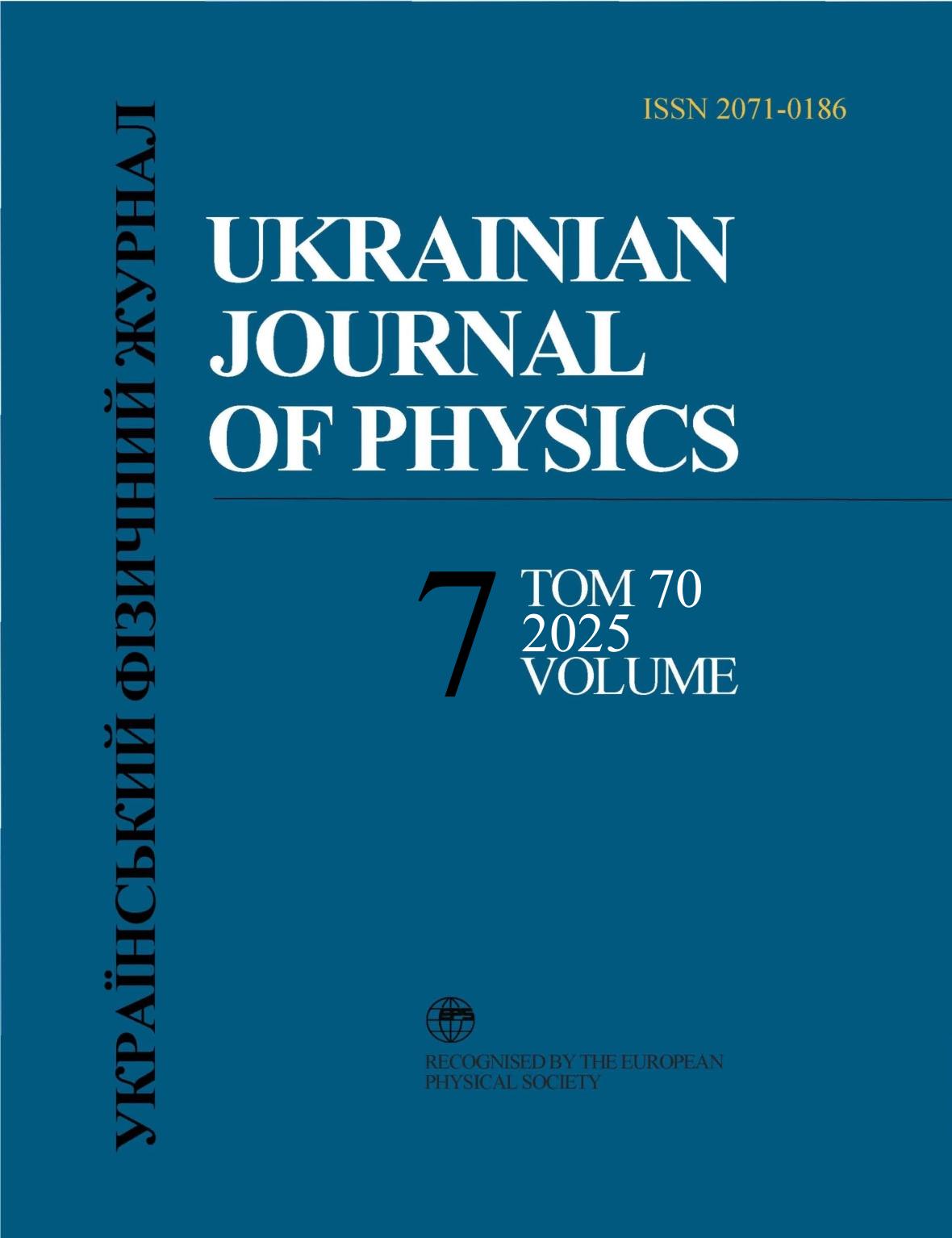
Similarity between the Electrophysical Properties of Albumin Macromolecules and the Magnetic Properties of Paramagnets
DOI:
https://doi.org/10.15407/ujpe70.7.460Keywords:
albumin macromolecule, zeta potential, acid-base balance indicator, zeta-potential critical pointAbstract
A similarity has been identified between the electrophysical phenomena in the aqueous-salt solutions of an albumin macromolecule and the magnetic properties of paramagnets. The character of the dependence of the zeta potential of albumin macromolecules on the pH indicator of acid-base balance in their aqueous-salt solutions is found on the basis of the paramagnet magnetization equation. It is also found that the asymmetry in the dependence of the zeta potential of albumin macromolecules on the difference pH − pH0, where pH0 is the pH value at the isoelectric point, does not exceed 30%. It has been proved that the region of physicochemical parameters of the aqueous-salt solutions of proteins in living organisms coincides with the applicability region of the Landau theory of second-order phase transitions.
References
1. Y. Li, N.G. Pinto. Model for ion-exchange equilibria of macromolecules in preparative chromatography. J. Chromatogr. A 702, 113 (1995).
https://doi.org/10.1016/0021-9673(94)01281-I
2. W. Kopaciewicz, M.A. Rounds, J. Fausnaugh, F.E. Regnier. Retention model for high-performance ion-exchange chromatography. J. Chromatogr. A 266, 3 (1983).
https://doi.org/10.1016/S0021-9673(01)90875-1
3. J. Fausnaugh-Pollitt, G. Thevenon, L. Janis, F.E. Regnier. Chromatographic resolution of lysozyme variants. J. Chromatogr. A 443, 221 (1988).
https://doi.org/10.1016/S0021-9673(00)94795-2
4. J.C. Bosma, J.A. Wesselingh. pH dependence of ion-exchange equilibrium of proteins. AIChE J. 44, 2399 (1998).
https://doi.org/10.1002/aic.690441108
5. M.O. Mchedlov-Petrosyan. Fundamentals of Colloidal Chemistry: Physical Chemistry of Dispersed Systems and Surface Phenomena (Kharkiv, 2004) (in Ukrainian) [ISBN: 966-623-288-X].
6. K.V. Fedorova. Optical Properties of Protein Macromolecules and Enzymes in Aqueous Solutions Containing Metal Ions. Ph.D. thesis (Moscow, 2016) (in Russian).
7. O.D. Stoliaryk, A.A. Guslisty, O.V. Khorolskyi. Temperature and concentration dependences of the zeta potential of albumin macromolecules in the aqueous-salt solution. Ukr. J. Phys. 68, 742 (2023).
https://doi.org/10.15407/ujpe68.11.742
8. K. Rezwan, L.P. Meier, M. Rezwan, J. V¨or¨os, M. Textor, L.J. Gauckler. Bovine serum albumin absorption onto colloidal Al2O3 particles: a new model based on zeta potential and UV-Vis measurements. Langmuir 20, 10055 (2004).
https://doi.org/10.1021/la048459k
9. B. Jachimska, M. Wasilewska, Z. Adamczyk. Characterization of globular protein solutions by dynamic light scattering, electrophoretic mobility, and viscosity measurements. Langmuir 24, 6866 (2008).
https://doi.org/10.1021/la800548p
10. M. Wasilewska, Z. Adamczyk, B. Jachimska. Structure of fibrinogen in electrolyte solutions derived from dynamic light scattering (DLS) and viscosity measurements. Langmuir 25, 3698 (2009).
https://doi.org/10.1021/la803662a
11. J.L. Oncley. Dielectric behavior and atomic structure of serum albumin. Biophys. Chem. 100, 151 (2002).
https://doi.org/10.1016/S0301-4622(02)00276-4
12. E.H. Grant, S.E. Keefe, S. Takashima. Dielectric behavior of aqueous solutions of bovine serum albumin from radiowave to microwave frequencies. J. Phys. Chem. 72, 4373 (1968).
https://doi.org/10.1021/j100859a004
13. A.L. Grebenev. Propaedeutics of Internal Diseases (Meditsyna, 2001) (in Russian).
14. O.V. Khorolskyi, N.P. Malomuzh. Macromolecular sizes of serum albumins in its aqueous solutions. AIMS Biophys. 7, 219 (2020).
https://doi.org/10.3934/biophy.2020017
15. V. Bardik, A.I. Fisenko, S. Magaz'u, N.P. Malomuzh. The crucial role of water in the formation of the physiological temperature range for warm-blooded organisms. J. Mol. Liq. 306, 112818 (2020).
https://doi.org/10.1016/j.molliq.2020.112818
16. N. Atamas, V. Bardik, A. Bannikova, O. Grishina, E. Lugovskoi, S. Lavoryk, Y. Makogonenko, V. Korolovych, D. Nerukh, V. Paschenko. The effect of water dynamics on conformation changes of albumin in pre-denaturation state: photon correlation spectroscopy and simulation. J. Mol. Liq. 235, 17 (2017).
https://doi.org/10.1016/j.molliq.2017.01.017
17. L.A. Bulavin, N.P. Malomuzh. Upper temperature limit for the existence of the alive matter. J. Mol. Liq. 124, 136 (2006).
https://doi.org/10.1016/j.molliq.2005.11.027
18. A.I. Fisenko, N.P. Malomuzh. Role of the H-bond network in the creation of life-giving properties of water. Chem. Phys. 345, 164 (2008).
https://doi.org/10.1016/j.chemphys.2007.08.013
19. L.A. Bulavin, N.P. Malomuzh. Dynamic phase transition in water as the most important factor in provoking protein denaturation in warm-blooded organisms. Fiz. Zhivogo 18, 16 (2010) (in Russian).
20. L.D. Landau, E.M. Lifshitz. Statistical Physics (Elsevier, 1980).
21. B. Tremey, B. Vigu'e. Changes in blood gases with temperature: implications for clinical practice. Ann. Fr. Anesth. Reanim. 23, 474 (2004).
https://doi.org/10.1016/S0750-7658(04)00097-8
22. D.V. Sivukhin. General Course of Physics. Vol. 3. Electricity (Nauka, 1989) (in Russian).
Downloads
Published
Issue
Section
License
Copyright Agreement
License to Publish the Paper
Kyiv, Ukraine
The corresponding author and the co-authors (hereon referred to as the Author(s)) of the paper being submitted to the Ukrainian Journal of Physics (hereon referred to as the Paper) from one side and the Bogolyubov Institute for Theoretical Physics, National Academy of Sciences of Ukraine, represented by its Director (hereon referred to as the Publisher) from the other side have come to the following Agreement:
1. Subject of the Agreement.
The Author(s) grant(s) the Publisher the free non-exclusive right to use the Paper (of scientific, technical, or any other content) according to the terms and conditions defined by this Agreement.
2. The ways of using the Paper.
2.1. The Author(s) grant(s) the Publisher the right to use the Paper as follows.
2.1.1. To publish the Paper in the Ukrainian Journal of Physics (hereon referred to as the Journal) in original language and translated into English (the copy of the Paper approved by the Author(s) and the Publisher and accepted for publication is a constitutive part of this License Agreement).
2.1.2. To edit, adapt, and correct the Paper by approval of the Author(s).
2.1.3. To translate the Paper in the case when the Paper is written in a language different from that adopted in the Journal.
2.2. If the Author(s) has(ve) an intent to use the Paper in any other way, e.g., to publish the translated version of the Paper (except for the case defined by Section 2.1.3 of this Agreement), to post the full Paper or any its part on the web, to publish the Paper in any other editions, to include the Paper or any its part in other collections, anthologies, encyclopaedias, etc., the Author(s) should get a written permission from the Publisher.
3. License territory.
The Author(s) grant(s) the Publisher the right to use the Paper as regulated by sections 2.1.1–2.1.3 of this Agreement on the territory of Ukraine and to distribute the Paper as indispensable part of the Journal on the territory of Ukraine and other countries by means of subscription, sales, and free transfer to a third party.
4. Duration.
4.1. This Agreement is valid starting from the date of signature and acts for the entire period of the existence of the Journal.
5. Loyalty.
5.1. The Author(s) warrant(s) the Publisher that:
– he/she is the true author (co-author) of the Paper;
– copyright on the Paper was not transferred to any other party;
– the Paper has never been published before and will not be published in any other media before it is published by the Publisher (see also section 2.2);
– the Author(s) do(es) not violate any intellectual property right of other parties. If the Paper includes some materials of other parties, except for citations whose length is regulated by the scientific, informational, or critical character of the Paper, the use of such materials is in compliance with the regulations of the international law and the law of Ukraine.
6. Requisites and signatures of the Parties.
Publisher: Bogolyubov Institute for Theoretical Physics, National Academy of Sciences of Ukraine.
Address: Ukraine, Kyiv, Metrolohichna Str. 14-b.
Author: Electronic signature on behalf and with endorsement of all co-authors.

.png)