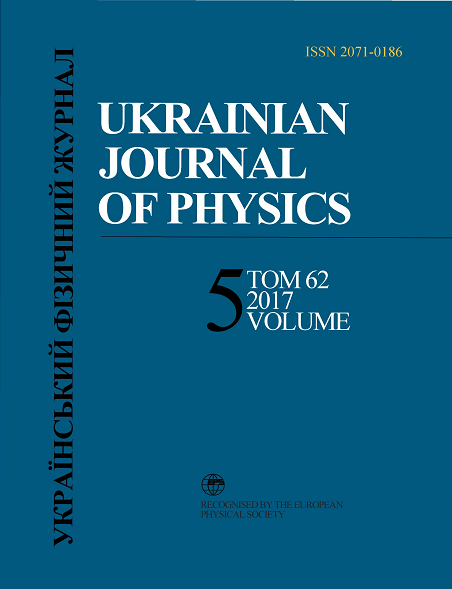
Вплив холодної пластичної деформацiї на електроопiр високоентропiйного сплаву CrMnFeCoNi
DOI:
https://doi.org/10.15407/ujpe62.05.0413Ключові слова:
high-entropy alloy, electrical resistivity, K-state, plastic deformation, structureАнотація
Дослiджено вплив холодної деформацiї вальцюванням на електротранспортнi властивостi високоентропiйного сплаву (ВЕСу) CrMnFeCoNi. Показано, що з ростом величини деформацiї при вальцюваннi, E, питомий електроопiр, p, цього сплаву зменшується, а температурний коефiцiєнт опору, a, зростає. При цьому, методом рентгенiвської дифракцiї нiяких фазових змiн не виявлено. Така поведiнка p та a вiд E вiдрiзняється вiд поведiнки цих величин бiльшостi традицiйних металевих сплавiв. Встановлено, що температурна залежнiсть електроопору при нагрiваннi деформованих зразкiв характеризується аномальною S-подiбною формою. По положенню таких S-аномалiй при рiзних швидкостях нагрiвання, методом Кiссiнджера визначено енергiю активацiї Ea процесу, що вiдповiдає за аномалiю. Форма залежностi p(T) та величина Ea дають пiдставу вiднести такi особливостi поведiнки p деформованих зразкiв до iснування в дослiдженому ВЕСi “К-стану”, що проявляється в деяких деформованих сплавах на основi перехiдних металiв. Обговорено можливi термодинамiчнi причини виникнення цього стану
Посилання
J.-W. Yeh, S.-K. Chen, S.-J. Lin, J.-Y. Gan, T.-S. Chin, T.-T. Shun, C.-H. Tsau, S.-Y. Chang. Nanostructured high-entropy alloys with multiple principal elements: novel alloy design concepts and outcomes. Adv. Eng. Mater. 6, 299 (2004).
https://doi.org/10.1002/adem.200300567
Y. Zhang, T.T. Zuo, Z. Tang, M.C. Gao, K.A. Dahmen, P.K. Liaw, Z.P. Lu. Microstructures and properties of highentropy alloys. Prog. Mater. Sci. 61, 1 (2014).
https://doi.org/10.1016/j.pmatsci.2013.10.001
O.N. Senkov, G.B. Wilks, D.B. Miracle, C.P. Chuang, P.K. Liaw. Refractory high-entropy alloys. Intermetallics 18, 1758 (2010).
https://doi.org/10.1016/j.intermet.2010.05.014
C.Y. Hsu, T.S. Sheu, J.W. Yeh, S.K. Chen. Effect of iron content on wear behaviour of AlCoCrFe Mo0.5Ni highentropy alloys. Wear 268, 653 (2010).
https://doi.org/10.1016/j.wear.2009.10.013
Y.J. Zhou, Y. Zhang, Y.L. Wang, G.L. Chen. Solid solution alloy of AlCoCrFeNiTi with excellent room-temperature mechanical properties. Appl. Phys. Lett. 90, 181904 (2007).
https://doi.org/10.1063/1.2734517
Y.-F. Kao, T.D. Lee, S.K. Chen, Y.S. Chang. Electrochemical passive properties of Al CoCrFeNi (= 0, 0.25,0.50, 1.00) alloys in sulfuric acids. Corros. Sci. 52, 1026 (2010).
https://doi.org/10.1016/j.corsci.2009.11.028
M.-H. Tsai, J.W. Yeh, J.Y. Gan. Diffusion barrier properties of AlMoNbSiTaTiVZr high-entropy alloy layer between copper and silicon. Thin Solid Films 516, 5527 (2008).
https://doi.org/10.1016/j.tsf.2007.07.109
M.S. Lucas, L. Mauger, J.A. Munoz, Y. Xiao, A.O. Sheets, S.L. Semiatin, J. Horwath, Z. Turgut. Magnetic and vibrational properties of high-entropy alloys. J. Appl. Phys. 109, 07E307 (2011).
K. Zhang, Z. Fu. Effects of annealing treatment on properties of CoCrFeNiTiAl multi-component alloys. Intermetallics 28, 34(2012).
https://doi.org/10.1016/j.intermet.2012.03.059
S.-K. Chen, Y.-F. Kao. Near-constant resistivity in 4.2-360 K in a B2 Al2.08CoCrFeNi. AIP Adv. 2, 012111 (2012).
https://doi.org/10.1063/1.3679072
M.-H. Tsai. Physical properties of high entropy alloys. Entropy 15, 5338 (2013).
https://doi.org/10.3390/e15125338
H.P. Chou, Y.S. Chang, S.K. Chen, J.W. Yeh. Microstructure, thermophysical and electrical properties in Al CoCrFeNi (0 ≤ ≤ 2) high-entropy alloy. Mater. Sci. Eng. 163, 184 (2009).
https://doi.org/10.1016/j.mseb.2009.05.024
Y.-F. Kao, S.-K. Chen, T.-J. Chen, P.-C. Chu, J.-W. Yeh, S.-J. Lin. Electrical, magnetic, and Hall properties of Al CoCrFeNi high-entropy alloys. J. Alloys Compd. 509, 1607 (2011).
https://doi.org/10.1016/j.jallcom.2010.10.210
M.O. Krapivka, Yu.P. Mazur, M.P. Semen'ko, S.A. Firstov. Structureof high-entropy alloys CrMnFeCoNi and CrMnFeCoNi2Cu and thermal stability of their charge transport properties. Metallofiz. Noveish. Tekhnol. 37, 731 (2015) (in Ukrainian).
https://doi.org/10.15407/mfint.37.06.0731
H.E. Kissinger. Reaction kinetics in differential thermal analysis. Anal. Chem. 29, 1702 (1957).
https://doi.org/10.1021/ac60131a045
F. Liu, F. Sommer, C. Bos, E.J. Mittemeijer. Analysis of solid state phase transformation kinetics: Models and recipes. Int. Mat. Rev. 52, 193 (2007).
https://doi.org/10.1179/174328007X160308
F. Otto, N.L. Hanold, E.P. George. Microstructural evolution after thermomechanical processing in an equiatomic, single-phase CoCrFeMnNi high-entropy alloy with special focus on twin boundaries. Intermetallics 54, 39 (2014).
https://doi.org/10.1016/j.intermet.2014.05.014
W.H. Liu, Y. Wu, J.Y. He, T.G. Nieh, Z.P. Lu. Grain growth and the Hall–Petch relationship in a high-entropy FeCrNiCoMn alloy. Scripta Materialia 68, 526 (2013).
https://doi.org/10.1016/j.scriptamat.2012.12.002
H. Thomas. Uber widerstandslegierungen. ¨ Z. Phys. 129, 219 (1951).
https://doi.org/10.1007/BF01333398
G. Grube, H. Schlecht. Electroconductivity and phase diagrams of binary alloys. Z. Elektrochem. 44, 413 (1938).
E. Ruedl, P. Delavignette, S. Amelinckx. Electron diffraction and electron microscopic study of long- and shortrange order in Ni4Mo and of the substructure resulting from ordering. Phys. Status Solidi 28, 305 (1968).
https://doi.org/10.1002/pssb.19680280132
J.E. Spruiell, E.E. Stansbury. X-ray study of short-range order in nickel alloys containing 10.7 and 20.0 at.% molybdenum. J. Phys. Chem. 26, 811 (1965).
https://doi.org/10.1016/0022-3697(65)90256-8
D.M.C. Nicholson, R.H. Brown. Electrical resistivity of Ni0.8Mo0.2: Explanation of anomalous behavior in shortrange ordered alloys. Phys. Rev. Lett. 70, 3311 (1993).
https://doi.org/10.1103/PhysRevLett.70.3311
Yu.N. Gornostyrev, M.I. Katsnelson. Misfit stabilized embedded nanoparticles in metallic alloys. Phys. Chem. Chem. Phys. 17, 27249 (2015).
https://doi.org/10.1039/C5CP04641F
S. Lowitzer, D. K¨odderitzsch, H. Ebert, P.R. Tulip, A. Marmodoro, J.B. Staunton. An ab initio investigation of how residual resistivity can decrease when an alloy is deformed. Europhys. Lett. 92, 37009 (2010).
https://doi.org/10.1209/0295-5075/92/37009
J.-W. Yeh, S.-Y. Changb, Y.-D. Honga, S.-K. Chenc, S.-J. Lin. Anomalous decrease in X-ray diffraction intensities of Cu–Ni–Al–Co–Cr–Fe–Si alloy systems with multiprincipal elements. Mater. Chem. Phys. 103, 41 (2007).
https://doi.org/10.1016/j.matchemphys.2007.01.003
E. Nunes, J.C.C. Freitas, R.D. Pereira, A.Y. Takeuchi, C. Larica, E.C. Passamani, A.A.R. Fernandes. Phase transformation in iron/cobalt-based amorphous alloys revealed by thermal and magnetic techniques. J. Alloys Comp. 369, 131 (2004).
https://doi.org/10.1016/j.jallcom.2003.09.072
Z. Stok losa, J. Rasek, P. Kwapuli’nski, G. Haneczok, G. Badura, J. Lelatko. Nanocrystallization of amorphous alloys based on iron. Mater. Sci. Eng. C 23, 49 (2003).
K.Y. Tsai, M.H. Tsai, J.W. Yeh. Sluggish diffusion in Co–Cr–Fe–Mn–Ni high-entropy alloys. Acta Mater. 61, 4887 (2013).
https://doi.org/10.1016/j.actamat.2013.04.058
C. Zhu, Z.P. Lu, T.G. Nieh. Incipient plasticity and dislocation nucleation of FeCoCrNiMn high-entropy alloy. Acta Mater. 61, 2993 (2013).
https://doi.org/10.1016/j.actamat.2013.01.059
F. Otto, Y. Yang, H. Bei, E.P. George. Relative effects of enthalpy and entropy on the phase stability of equiatomic high-entropy alloys. Acta Mater. 61, 2628 (2013).
https://doi.org/10.1016/j.actamat.2013.01.042
A. Takeuchi, A. Inoue. Classification of bulk metallic glasses by atomic size difference, heat of mixing and period of constituent elements and its application to characterization of the main alloying element. Mater. Trans. 46, 2817 (2005).
Завантаження
Опубліковано
Номер
Розділ
Ліцензія
Ліцензійний Договір
на використання Твору
м. Київ, Україна
Відповідальний автор та співавтори (надалі іменовані як Автор(и)) статті, яку він (вони) подають до Українського фізичного журналу, (надалі іменована як Твір) з одного боку та Інститут теоретичної фізики імені М.М. Боголюбова НАН України в особі директора (надалі – Видавець) з іншого боку уклали даний Договір про таке:
1. Предмет договору.
Автор(и) надає(ють) Видавцю безоплатно невиключні права на використання Твору (наукового, технічного або іншого характеру) на умовах, визначених цим Договором.
2. Способи використання Твору.
2.1. Автор(и) надає(ють) Видавцю право на використання Твору таким чином:
2.1.1. Використовувати Твір шляхом його видання в Українському фізичному журналі (далі – Видання) мовою оригіналу та в перекладі на англійську (погоджений Автором(ами) і Видавцем примірник Твору, прийнятого до друку, є невід’ємною частиною Ліцензійного договору).
2.1.2. Переробляти, адаптувати або іншим чином змінювати Твір за погодженням з Автором(ами).
2.1.3. Перекладати Твір у випадку, коли Твір викладений іншою мовою, ніж мова, якою передбачена публікація у Виданні.
2.2. Якщо Автор(и) виявить(лять) бажання використовувати Твір в інший спосіб, як то публікувати перекладену версію Твору (окрім випадку, зазначеного в п. 2.1.3 цього Договору); розміщувати повністю або частково в мережі Інтернет; публікувати Твір в інших, у тому числі іноземних, виданнях; включати Твір як складову частину інших збірників, антологій, енциклопедій тощо, то Автор(и) мають отримати на це письмовий дозвіл від Видавця.
3. Територія використання.
Автор(и) надає(ють) Видавцю право на використання Твору способами, зазначеними у п.п. 2.1.1–2.1.3 цього Договору, на території України, а також право на розповсюдження Твору як невід’ємної складової частини Видання на території України та інших країн шляхом передплати, продажу та безоплатної передачі третій стороні.
4. Строк, на який надаються права.
4.1. Договір є чинним з дати підписання та діє протягом усього часу функціонування Видання.
5. Застереження.
5.1. Автор(и) заявляє(ють), що:
– він/вона є автором (співавтором) Твору;
– авторські права на даний Твір не передані іншій стороні;
– даний Твір не був раніше опублікований і не буде опублікований у будь-якому іншому виданні до публікації його Видавцем (див. також п. 2.2);
– Автор(и) не порушив(ли) права інтелектуальної власності інших осіб. Якщо у Творі наведені матеріали інших осіб за виключенням випадків цитування в обсязі, виправданому науковим, інформаційним або критичним характером Твору, використання таких матеріалів здійснене Автором(ами) з дотриманням норм міжнародного законодавства і законодавства України.
6. Реквізити і підписи сторін.
Видавець: Інститут теоретичної фізики імені М.М. Боголюбова НАН України.
Адреса: м. Київ, вул. Метрологічна 14-б.
Автор: Електронний підпис від імені та за погодження всіх співавторів.

.png)