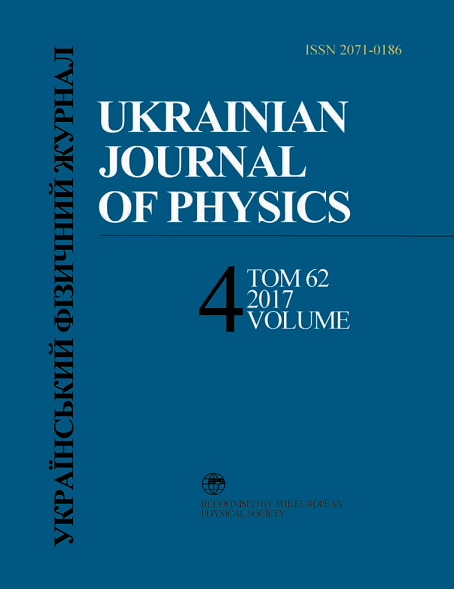
Miniband Electrical Conductivity in Superlattices of Spherical InAs/GaAs Quantum Dots
DOI:
https://doi.org/10.15407/ujpe62.04.0334Keywords:
quantum dot, superlattice, electron states, miniband, electrical conductivityAbstract
The electrical properties of nanoscale semiconductor InAs/GaAs heterosystems with 2D-superlattices of spherical quantum dots have been studied. The dependences of the electron group velocity on the wave vector and the miniband quantum number are obtained. The dependences of the Fermi level of electrons in minibands on the concentration of donor impurities, donor energy, and temperature are found. The temperature dependences of the majority carrier concentration and the electrical conductivity are analyzed for various donor concentrations and energies.
References
I.D. Rukhlenko, D. Handapangoda, M. Premaratne, A.V. Fedorov, A.V. Baranov, C. Jagadish. Spontaneous emission of guided polaritons by quantum dot coupled to metallic nanowire: Beyond the dipole approximation. Opt. Express 17, 17570 (2009). 340 ISSN 2071-0194. Ukr. J. Phys. 2017. Vol. 62, No. 4
X.L. Wu, F.S. Xue. Optical transition in discrete levels of Si quantum dots. Appl. Phys. Lett. 84, 2808 (2004).
https://doi.org/10.1063/1.1704872
O.B. Shchekin, G. Park, D.L. Huffaker, D.G. Deppe. Discrete energy level separation and the threshold temperature dependence of quantum dot lasers. Appl. Phys. Lett. 77, 466 (2000).
https://doi.org/10.1063/1.127012
A.V. Fedorov, I.D. Rukhlenko, A.V. Baranov, S.Yu. Kruchinin. Optical Properties of Semiconductor Quantum Dots (Nauka, 2011) (in Russian).
Semiconductor Quantum Dots, edited by Y. Masumoto, T. Takagahara (Springer, 2002) [ISBN: 978-3-662-05001-9].
https://doi.org/10.1007/978-3-662-05001-9
S.M. Reimann, M. Manninen. Electronic structure of quantum dots. Rev. Mod. Phys. 74, 1283 (2002).
https://doi.org/10.1103/RevModPhys.74.1283
A.D. Yoffe. Semiconductor quantum dots and related systems: Electronic, optical, luminescence and related properties of low dimensional systems. Adv. Phys. 50, 1 (2001).
https://doi.org/10.1080/00018730010006608
I.D. Rukhlenko, M.Y. Leonov, V.K. Turkov, A.P. Litvin, A.S. Baimuratov, A.V. Baranov, A.V. Fedorov. Kinetics of pulse-induced photoluminescence from a semiconductor quantum dot. Opt. Express 20, 27612 (2012).
https://doi.org/10.1364/OE.20.027612
A.S. Baimuratov. Shape-induced anisotropy of intraband luminescence from a semiconductor nanocrystal. Opt. Lett. 37, 4645 (2012).
https://doi.org/10.1364/OL.37.004645
D. Press, Th.D. Ladd, B. Zhang, Y. Yamamoto. Complete quantum control of a single quantum dot spin using ultrafast optical pulses. Nature 456, 218 (2008).
https://doi.org/10.1038/nature07530
A.V. Baranov, A.V. Fedorov, I.D. Rukhlenko, Y. Masumoto. Intraband carrier relaxation in quantum dots embedded in doped heterostructures. Phys. Rev. B 68, 205318 (2003).
https://doi.org/10.1103/PhysRevB.68.205318
V.I. Boichuk, I.V. Bilynskyi, R.Ya. Leshko, L.M. Turyanska. Optical properties of a spherical quantum dot with two ions of hydrogenic impurity. Physica E 54, 281 (2013).
https://doi.org/10.1016/j.physe.2013.07.003
V.I. Boichuk, I.V. Bilynsky, I.O. Shakleina, I. Kogoutiouk. Dielectric mismatch in finite barrier cubic quantum dots. Physica E 43, 161 (2010).
https://doi.org/10.1016/j.physe.2010.06.031
A.J. Shields. Semiconductor quantum light sources. Nat. Photon. 1, 215 (2007).
https://doi.org/10.1038/nphoton.2007.46
K.J. Vahala. Optical microcavities. Nature 424, 839 (2003).
https://doi.org/10.1038/nature01939
V.I. Klimov, A.A. Mikhailovsky, S. Xu, A. Malko. Optical gain and stimulated emission in nanocrystal quantum dots. Science 290, 314 (2000).
https://doi.org/10.1126/science.290.5490.314
Z.L. Yuan, B.E. Kardynal, R.M. Stevenson, A.J. Shields, C.J. Lobo, K. Cooper, N.S. Beattie, D.A. Ritchie, M. Pepper. Electrically driven single-photon source. Science 295, 102 (2002).
https://doi.org/10.1126/science.1066790
A.J. Bennett, D.C. Unitt, P. See, A.J. Shields, P. Atkinson, K. Cooper, D.A. Ritchie. Microcavity single-photonemitting diode. Appl. Phys. Lett. 86, 181102 (2005).
https://doi.org/10.1063/1.1921332
P. Michler, A. Kiraz, C. Becher, W.V. Schoenfeld, P.M. Petroff, L. Zhang, E. Hu, A. Imamoglu. A quantum dot singlephoton turnstile device. Science 290, 2282 (2000)].
https://doi.org/10.1126/science.290.5500.2282
K. Tanabe, K. Watanabe, Y. Arakawa. III-V/Si hybrid photonic devices by direct fusion bonding. Sci. Rep. 2, 349 (2012).
https://doi.org/10.1038/srep00349
J. Jasieniak, B.I. MacDonald, S.E. Watkins, P. Mulvaney. Solution-processed sintered nanocrystal solar cells via layer-by-layer assembly. Nano Lett. 11, 2856 (2011).
https://doi.org/10.1021/nl201282v
I. Gur, N.A. Fromer, M.L. Geier, A.P. Alivisatos. Airstable all-inorganic nanocrystal solar cells processed from solution. Science 310, 462 (2005).
https://doi.org/10.1126/science.1117908
P. Prabhakaran, W.J. Kim, K.S. Lee, P.N. Prasad. Quantum dots (QDs) for photonic applications. Opt. Mater. Express 2, 578 (2012).
https://doi.org/10.1364/OME.2.000578
S.A. McDonald, G. Konstantatos, S. Zhang, P.W. Cyr, E.J.D. Klem, L. Levina, E.H. Sargent. Solution-processed PbS quantum dot infrared photodetectors and photovoltaics. Nat. Mater. 4, 138 (2005).
https://doi.org/10.1038/nmat1299
D. Qi, M. Fischbein, M. Drndi’c, S. Selmi’c. Efficient poly- ˇmer-nanocrystal quantum-dot photodetectors. Appl. Phys. Lett. 86, 093103 (2005).
https://doi.org/10.1063/1.1872216
N.V. Tkach, A.M. Makhanets, G.G. Zegrya. Energy spectrum of electron in quasiplane superlattice of cylindrical quantum dots. Semicond. Sci. Technol. 15, 395 (2000).
https://doi.org/10.1088/0268-1242/15/4/315
N.V. Tkach, Yu.A. Seti. Optimization of the configuration of symmetric three-barrier resonance-tunnel structure as an active element of a quantum cascade detector. Fiz. Tekh. Poluprovodn. 45, 387 (2011) (in Russian).
Ju.O. Seti, M.V. Tkach, I.V. Boyko. Influence of non-linear electrons interaction at their transport through the symmetric two- barrier resonance nano-system. J. Optoelectron. Adv. Mater. 14, 393 (2012).
V.A. Holovatsky, V.I. Gutsul, O.M. Makhanets. Energy spectrum of electron in superlattice along the elliptic nanowire. Rom. J. Phys. 52, 327 (2007).
O.L. Lazarenkova, A.A. Balandin. Miniband formation in a quantum dot crystal. J. Appl. Phys. 89, 5509 (2001).
https://doi.org/10.1063/1.1366662
O.L. Lazarenkova, A.A. Balandin. Electron and phonon energy spectra in a three-dimensional regimented quantum dot superlattice. Phys. Rev. B 66, 245319 (2002).
https://doi.org/10.1103/PhysRevB.66.245319
V.I. Boichuk, I.V. Bilynsky, R.I. Pazyuk, I.O. Shakleina. Energy spectrum of charges in a periodic system of spherical quantum dots. Fiz. Khim. Tverd. Tila 10, 752 (2009) (in Ukrainian).
V.I. Boichuk, I.V. Bilynsky, R.I. Pazyuk. Coefficient of light absorption induced by electron intersubband transitions in superlattices of spherical quantum dots. Zh. Fiz. Dosl. 19, 1601 (2015) (in Ukrainian).
V. Boichuk. Fundamentals of Solid State Theory: A Tutorial (Kolo, 2010) (in Ukrainian).
R. Mohan, Y. Liang. Intersublevel relaxation properties of self-assembled InAs/GaAs quantum dot heterostructures. In Cutting Edge Nanotechnology (InTech, 2010), p. 316 [ISBN: 978-953-7619-93-0].
V.I. Boichuk, I.V. Bilynskyi, O.A. Sokolnyk, I.O. Shakleina. Effect of quantum dot shape of the GaAs/AlAs heterostructure on interlevel hole light absorption. Cond. Matter Phys. 16, 33702 (2013).
Downloads
Published
Issue
Section
License
Copyright Agreement
License to Publish the Paper
Kyiv, Ukraine
The corresponding author and the co-authors (hereon referred to as the Author(s)) of the paper being submitted to the Ukrainian Journal of Physics (hereon referred to as the Paper) from one side and the Bogolyubov Institute for Theoretical Physics, National Academy of Sciences of Ukraine, represented by its Director (hereon referred to as the Publisher) from the other side have come to the following Agreement:
1. Subject of the Agreement.
The Author(s) grant(s) the Publisher the free non-exclusive right to use the Paper (of scientific, technical, or any other content) according to the terms and conditions defined by this Agreement.
2. The ways of using the Paper.
2.1. The Author(s) grant(s) the Publisher the right to use the Paper as follows.
2.1.1. To publish the Paper in the Ukrainian Journal of Physics (hereon referred to as the Journal) in original language and translated into English (the copy of the Paper approved by the Author(s) and the Publisher and accepted for publication is a constitutive part of this License Agreement).
2.1.2. To edit, adapt, and correct the Paper by approval of the Author(s).
2.1.3. To translate the Paper in the case when the Paper is written in a language different from that adopted in the Journal.
2.2. If the Author(s) has(ve) an intent to use the Paper in any other way, e.g., to publish the translated version of the Paper (except for the case defined by Section 2.1.3 of this Agreement), to post the full Paper or any its part on the web, to publish the Paper in any other editions, to include the Paper or any its part in other collections, anthologies, encyclopaedias, etc., the Author(s) should get a written permission from the Publisher.
3. License territory.
The Author(s) grant(s) the Publisher the right to use the Paper as regulated by sections 2.1.1–2.1.3 of this Agreement on the territory of Ukraine and to distribute the Paper as indispensable part of the Journal on the territory of Ukraine and other countries by means of subscription, sales, and free transfer to a third party.
4. Duration.
4.1. This Agreement is valid starting from the date of signature and acts for the entire period of the existence of the Journal.
5. Loyalty.
5.1. The Author(s) warrant(s) the Publisher that:
– he/she is the true author (co-author) of the Paper;
– copyright on the Paper was not transferred to any other party;
– the Paper has never been published before and will not be published in any other media before it is published by the Publisher (see also section 2.2);
– the Author(s) do(es) not violate any intellectual property right of other parties. If the Paper includes some materials of other parties, except for citations whose length is regulated by the scientific, informational, or critical character of the Paper, the use of such materials is in compliance with the regulations of the international law and the law of Ukraine.
6. Requisites and signatures of the Parties.
Publisher: Bogolyubov Institute for Theoretical Physics, National Academy of Sciences of Ukraine.
Address: Ukraine, Kyiv, Metrolohichna Str. 14-b.
Author: Electronic signature on behalf and with endorsement of all co-authors.

.png)