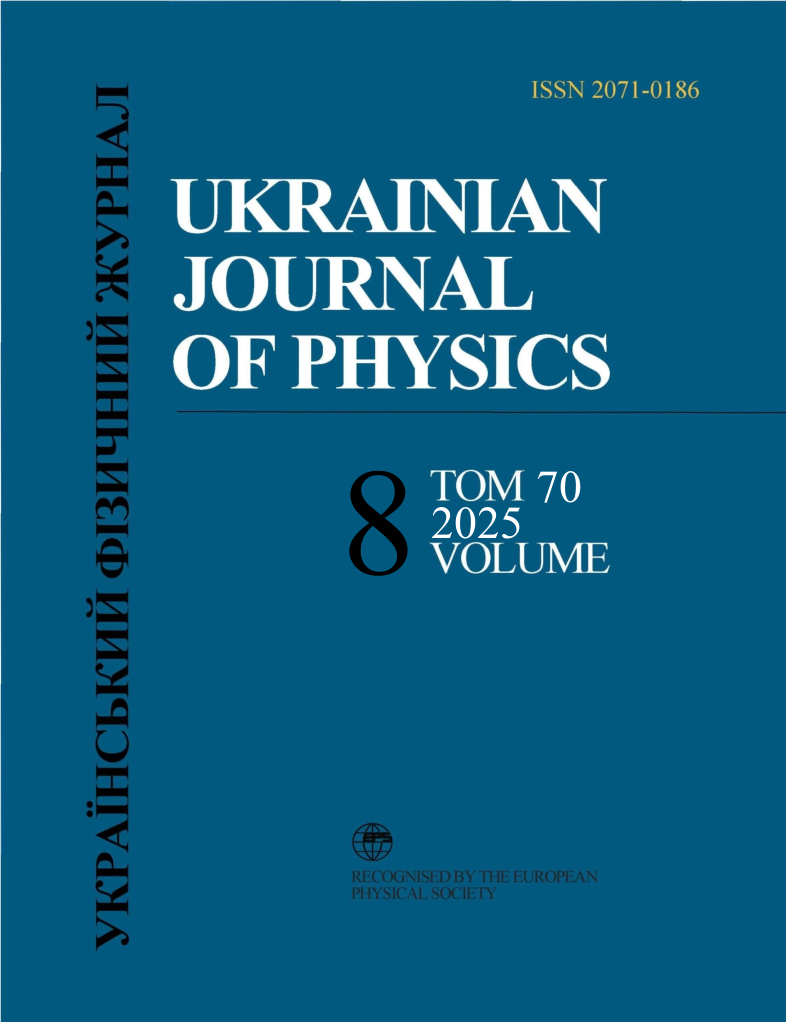
On the Excitation Mechanism of Hybrid Plasmon-Polaritons in Semiconductors
DOI:
https://doi.org/10.15407/ujpe70.8.531Keywords:
electrons, holes, electric field, polarization, electric current density, plasmon frequency, spatial dispersion, dispersion equation, instability, bulk plasmons, surface plasmons, bulk polaritons, surface polaritons, increment, decrementAbstract
The influence of direct current on the dynamics of plasmon-polaritons in semiconductors has been analyzed. It is shown that the counter motion of macroscopic continua of electrons and holes induced by an external electromotive force leads to the appearance of unstable additional hybrid bulk and surface plasmons, as well as plasmon-polaritons, which are “genetically” related to both electrons and holes. The dispersion law and the increment and decrement of the amplitudes of the dynamic variables of additional hybrid plasmons and plasmon-polaritons are demonstrated to substantially depend on the stationary motion velocity of charged particles associated with the constant direct current. It is shown that one of the solutions of the dispersion equation for surface plasmon-polaritons corresponds to “exotic” bulk plasmon-polaritons, which propagate from the air-semiconductor interface into the depth of contacting media. The instability of additional hybrid plasmons and plasmon-polaritons can be used as the basis for a simple method of excitating additional hybrid plasmons and plasmon-polaritons in semiconductors.
References
1. N.B. Brandt, V.A. Kulbachinskii. Quasiparticles in Condensed Matter Physics (Fizmatlit, 2007) (in Russian) [ISBN: 5-9221-0564-7].
2. S.A. Maier. Plasmonics: Fundamentals and Applications (Springer Science + Bussiness Media LLC, 2007) [ISBN: 0-387-33150-6].
https://doi.org/10.1007/0-387-37825-1
3. S. Enoch, N. Bonod. Plasmonics: From Basics to Advanced Topics (Springer, 2012) [ISBN-10: 3642280781; ISBN-13: 978-3642280788].
https://doi.org/10.1007/978-3-642-28079-5
4. M.M. Chepilko, S.O. Ponomarenko. The generalized Drude-Lorentz model and its application in metalloplasmonics. Ukr. J. Phys. 67, 431 (2022).
https://doi.org/10.15407/ujpe67.6.431
5. M.M. Chepilko, S.O. Ponomarenko. Problematic issues of metal plasmonics of bulk polaritons in the magnetostatic field. Ukr. J. Phys. 67, 455 (2022).
https://doi.org/10.15407/ujpe67.6.455
6. Yu.E. Lozovik. Plasmonics and magnetoplasmonics on graphene and topological insulator. Usp. Fiz. Nauk 182, 1111 (2012) (in Russian).
https://doi.org/10.3367/UFNr.0182.201210h.1111
7. M. Dyakonov, M. Shur. Shallow water analogy for a ballistic field effect transistor: New mechanism of plasma wave generation by dc current. Phys. Rev. Lett. 71, 2465 (1993).
https://doi.org/10.1103/PhysRevLett.71.2465
8. S.M. Kukhtaruk. High-frequency properties of systems with drifting electrons and polar optical phonons. Semicond. Phys. Quant. Electron. Optoelectron. 11, 43 (2008).
https://doi.org/10.15407/spqeo11.01.043
9. O. Sydoruk, V. Kalinin, L. Solymar. Terahertz instability of optical phonons interacting with plasmons in two-dimensional electron channels. Appl. Phys. Lett. 97, 062107 (2010).
https://doi.org/10.1063/1.3479416
10. V.A. Kochelap, S.M. Kukhtaruk. THz electrical instability of a hybrid system composed of quantum dot and quantum well with drifting electrons. J. Appl. Phys. 109, 114318 (2011).
https://doi.org/10.1063/1.3594682
11. S.O. Yakushev, S.I. Petrov, A.V. Shulika, I.A. Sukhoivanov. Generation of terahertz radiation by femtosecond lasers of the optical range. Radiotehnila 167, 102 (2011) (in Russian).
12. S. Boubanga-Tombet et al. Room-temperature amplification of terahertz radiation by grating-gate graphene structures. Phys. Rev. X 10, 031004 (2020).
https://doi.org/10.1103/PhysRevX.10.031004
13. V.V. Gerasimov, A.K. Nikitin, A.G. Lemzyakov, I.A. Azarov. Evaluation of the efficiency of generation of terahertz surface plasmon polaritons by the end-fire coupling technique. Photonics 10, 917 (2023).
https://doi.org/10.3390/photonics10080917
14. New Semiconductor Materials. Characteristics and Properties ; http://www.ioffe.ru/SVA/NSM/Semicond/InSb/index.html.
15. A.F. Alexandrov, L.S. Bogdankevich, A.A. Rukhadze. Fundamentals of Plasma Electrodynamics (Vysshaya shkola, 1978) (in Russian).
16. E.M. Lifshitz, L.P. Pitaevsky. Physical Kinetics (Pergamon Press, 1979).
17. A.I. Maimistov. Electrodynamics of Continuous Media (MFTI, 2015) (in Russian).
18. L.D. Landau, E.M. Lifshits. Electrodynamics of Continuous Media (Pergamon Press, 1984).
Downloads
Published
Issue
Section
License
Copyright Agreement
License to Publish the Paper
Kyiv, Ukraine
The corresponding author and the co-authors (hereon referred to as the Author(s)) of the paper being submitted to the Ukrainian Journal of Physics (hereon referred to as the Paper) from one side and the Bogolyubov Institute for Theoretical Physics, National Academy of Sciences of Ukraine, represented by its Director (hereon referred to as the Publisher) from the other side have come to the following Agreement:
1. Subject of the Agreement.
The Author(s) grant(s) the Publisher the free non-exclusive right to use the Paper (of scientific, technical, or any other content) according to the terms and conditions defined by this Agreement.
2. The ways of using the Paper.
2.1. The Author(s) grant(s) the Publisher the right to use the Paper as follows.
2.1.1. To publish the Paper in the Ukrainian Journal of Physics (hereon referred to as the Journal) in original language and translated into English (the copy of the Paper approved by the Author(s) and the Publisher and accepted for publication is a constitutive part of this License Agreement).
2.1.2. To edit, adapt, and correct the Paper by approval of the Author(s).
2.1.3. To translate the Paper in the case when the Paper is written in a language different from that adopted in the Journal.
2.2. If the Author(s) has(ve) an intent to use the Paper in any other way, e.g., to publish the translated version of the Paper (except for the case defined by Section 2.1.3 of this Agreement), to post the full Paper or any its part on the web, to publish the Paper in any other editions, to include the Paper or any its part in other collections, anthologies, encyclopaedias, etc., the Author(s) should get a written permission from the Publisher.
3. License territory.
The Author(s) grant(s) the Publisher the right to use the Paper as regulated by sections 2.1.1–2.1.3 of this Agreement on the territory of Ukraine and to distribute the Paper as indispensable part of the Journal on the territory of Ukraine and other countries by means of subscription, sales, and free transfer to a third party.
4. Duration.
4.1. This Agreement is valid starting from the date of signature and acts for the entire period of the existence of the Journal.
5. Loyalty.
5.1. The Author(s) warrant(s) the Publisher that:
– he/she is the true author (co-author) of the Paper;
– copyright on the Paper was not transferred to any other party;
– the Paper has never been published before and will not be published in any other media before it is published by the Publisher (see also section 2.2);
– the Author(s) do(es) not violate any intellectual property right of other parties. If the Paper includes some materials of other parties, except for citations whose length is regulated by the scientific, informational, or critical character of the Paper, the use of such materials is in compliance with the regulations of the international law and the law of Ukraine.
6. Requisites and signatures of the Parties.
Publisher: Bogolyubov Institute for Theoretical Physics, National Academy of Sciences of Ukraine.
Address: Ukraine, Kyiv, Metrolohichna Str. 14-b.
Author: Electronic signature on behalf and with endorsement of all co-authors.

.png)