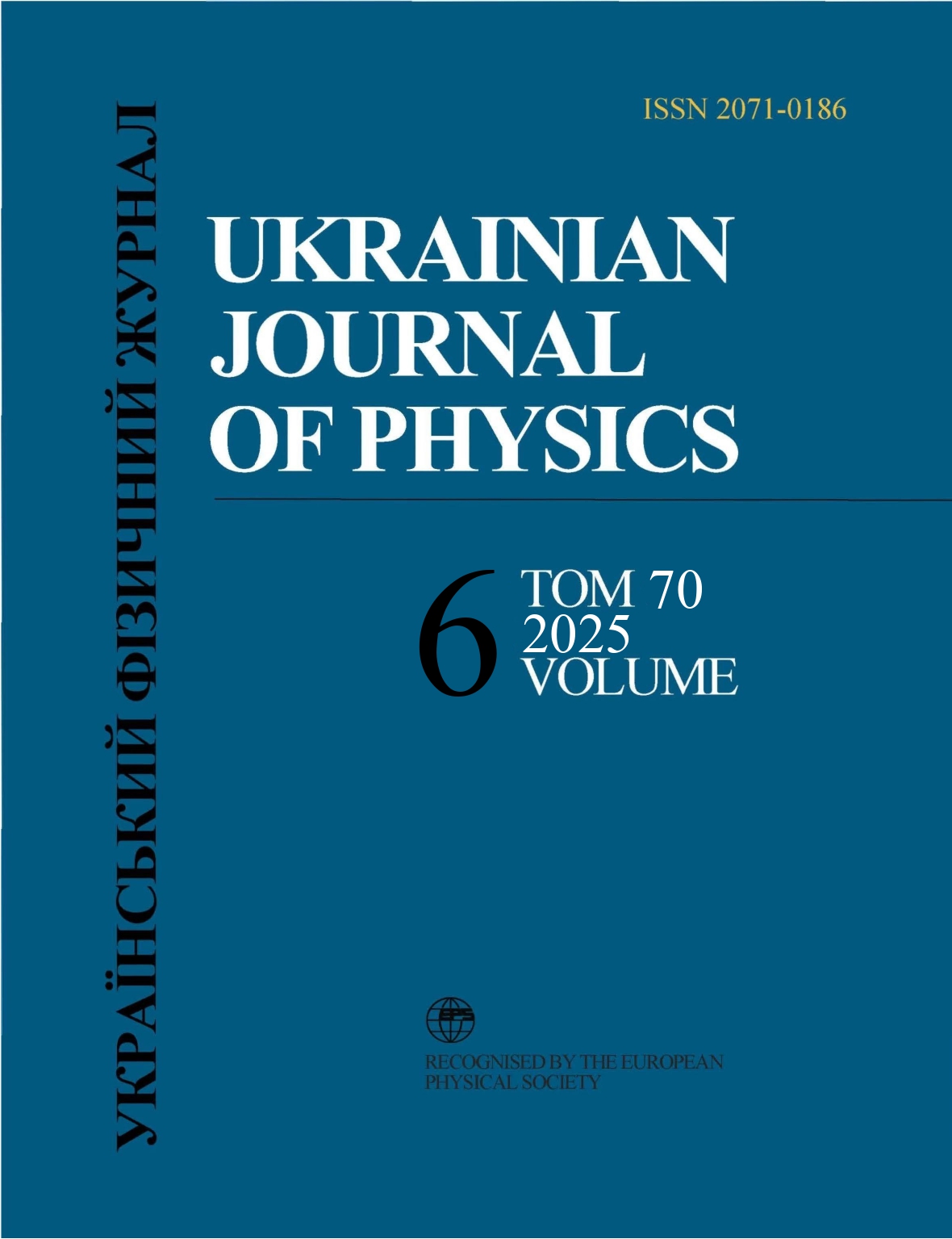
Nonlinearities in Magnetic Confinement, Ionospheric Physics, and Population Explosion Leading to Profile Resilience
DOI:
https://doi.org/10.15407/ujpe70.6.373Keywords:
magnetic confinement, nonlinearities, resonance broadening, drift waves, tokamaks, profile resilienceAbstract
Nonlinearities play an important role in many fields. In the field of thermonuclear fusion, they are involved in questions such as profile resilience and fluid closure. A nonlinear phenomenon common to both fusion and astrophysical planets is the generation of zonal flows. These flows play a significant role in determining the level of turbulence and fluid closure in fusion. The effects of resonance broadening and nonlinearities are investigated, specifically focusing on the case of nonlinear instability that has appeared in drift waves. Similarities and differences between our systems are discussed, with population explosion and the dynamics of nonlinear systems for drift waves by different states in profile resilience described with great precision. The aim of our study is to put our fluid model for drift waves in tokamaks within the wider framework of statistical physics principles. This reinforces our belief in the broad application of our drift wave model, which encompasses current tokamaks, ITER, and the fusion pilot plant.
References
1. T.H. Dupree, A perturbation theory for strong plasma turbulence. Phys. Fluids 9, 1773 (1966).
https://doi.org/10.1063/1.1761932
2. B. Coppi, M. Rosenbluth, R. Sudan. Nonlinear interactions of positive and negative energy modes in rarefied plasmas. Ann. Phys. 55, 207 (1969).
https://doi.org/10.1016/0003-4916(69)90178-X
3. A. Hasegawa. Plasma Instabilities and Nonlinear Effects (Springer, 1975).
https://doi.org/10.1007/978-3-642-65980-5
4. J. Weiland, H. Wilhelmsson. Coherent Non-linear Interaction of Waves in Plasmas (Pergamon Press, 1977).
https://doi.org/10.1007/978-1-4757-1571-2_29
5. J.W. Connor, R.J. Hastie, J.B. Taylor. Shear, periodicity, and plasma ballooning modes. Phys. Rev. Lett. 40, 396 (1978).
https://doi.org/10.1103/PhysRevLett.40.396
6. A. Hasegawa, K. Mima. Pseudo three dimensional turbulence in magnetized nonuniform plasma. Phys. Fluids 21, 87 (1978).
https://doi.org/10.1063/1.862083
7. J.D. Huba, K. Papadopoulos. Nonlinear stabilization of the lower hybrid drift instability by electron resonance broadening. Phys. Fluids 21, 121 (1978).
https://doi.org/10.1063/1.862072
8. B. Coppi. Nonclassical transport and the principle of profile consistency. Comments Plasma Phys. Controlled Fusion 5, 261 (1980).
9. M. Wakatani, A. Hasegawa. A collisional drift wave description of plasma edge turbulence, Phys. Fluids 27, 611 (1984).
https://doi.org/10.1063/1.864660
10. J. Weiland, H. Nordman. Theory of fusion plasmas. In: Proc. Varenna-Lausanne Workshop, Chexbres 1988, Bologna Editrice Compostori (1988), p. 451.
11. J. Weiland, A. Jarm'en, H. Nordman. Diffusive particle and heat pinch effects in toroidal plasmas. Nucl. Fusion 29, 1810 (1989).
https://doi.org/10.1088/0029-5515/29/10/015
12. T.C. Luce, C.C. Petty, J.C.M. de Haas. Inward energy transport in tokamak plasmas. Phys. Rev. Lett. 68, 52 (1992).
https://doi.org/10.1103/PhysRevLett.68.52
13. J. Weiland, H. Nordman. Drift wave model for inward energy transport in tokamak plasmas. Phys. Fluids B 5, 1669 (1993).
https://doi.org/10.1063/1.860801
14. F. Wagner, U. Stroth. Transport in toroidal devices' the experimentalist's view. Plasma Phys. Controlled Fusion 35, 1321 (1993).
https://doi.org/10.1088/0741-3335/35/10/002
15. A.J. Redd, A.H. Kritz, G. Bateman, G. Rewoldt, W.M. Tang. Drift mode growth rates and associated transport. Phys. Plasmas 6, 1162 (1999).
https://doi.org/10.1063/1.873360
16. A. Zagorodny, J. Weiland. Statistical theory of turbulent transport (non-Markovian effects). Phys. Plasmas 6, 2359 (1999).
https://doi.org/10.1063/1.873507
17. J.W. Connor, O.P. Pogutse. On the relationship between mixing length and strong turbulence estimates for transport due to drift turbulence. Plasma Phys. Controlled Fusion 43, 155 (2001).
https://doi.org/10.1088/0741-3335/43/2/306
18. J. Weiland, I. Holod. Drift wave transport scalings introduced by varying correlation length. Phys. Plasmas 12, 012505 (2004).
https://doi.org/10.1063/1.1828083
19. C. Bourdelle, X. Garbet, F. Imbeaux, A. Casati, N. Dubuit, R. Guirlet, T. Parisot. A new gyrokinetic quasilinear transport model applied to particle transport in tokamak plasmas. Phys. Plasmas 14, 112501 (2007).
https://doi.org/10.1063/1.2800869
20. J. Weiland, K. Crombe, P. Mantica, V. Naulin, T. Tala. JET-EFDA Contributors. Comparison of edge and internal transport barriers in drift wave predictive simulations. AIP Conf. Proc. 1392, 85 (2011).
https://doi.org/10.1063/1.3647234
21. G.Q. Wang, J. Ma, J. Weiland. Zonal flows near marginal stability in drift wave transport. Phys. Scr. 90, 065604 (2015).
https://doi.org/10.1088/0031-8949/90/6/065604
22. A.M. Dimits, G. Bateman, M.A. Beer, B.I. Cohen, W. Dorland, G.W. Hammett, C. Kim, J.E. Kinsey, M. Kotschenreuther, A.H. Kritz et al. Comparisons and physics basis of tokamak transport models and turbulence simulations. Phys. Plasmas 7, 969 (2000).
https://doi.org/10.1063/1.873896
23. J. Weiland. Simulations of the L-H transition on experimental advanced superconducting Tokamak. Phys. Plasmas 21, 122501 (2014).
https://doi.org/10.1063/1.4901597
24. A.C. Boxer, R. Bergmann, J.L. Ellsworth, D.T. Garnier, J. Kesner, M.E. Mauel, P. Woskov. Turbulent inward pinch of plasma confined by a levitated dipole magnet. Nat. Phys. 6, 207 (2010).
https://doi.org/10.1038/nphys1510
25. J. Weiland. Turbulence at a pinch. Nat. Phys. 6, 167 (2010).
https://doi.org/10.1038/nphys1618
26. J. Weiland. Stability and Transport in Magnetic Confinement Systems (Springer, 2012).
https://doi.org/10.1007/978-1-4614-3743-7
27. W.L. Zhong, X.L. Zou, C. Bourdelle, S.D. Song, J.F. Artaud, T. Aniel, X.R. Duan. Convective velocity reversal caused by turbulence transition in tokamak plasma. Phys. Rev. Lett. 111, 265001 (2013).
https://doi.org/10.1103/PhysRevLett.111.265001
28. J. Ma, G. Wang, J. Weiland, T. Rafiq, A.H. Kritz. Reversal of particle flux in collisional-finite beta tokamak discharges. Phys. Plasmas 22, 012304 (2015).
https://doi.org/10.1063/1.4905628
29. T. Rafiq, A.H. Kritz, J. Weiland, A.Y. Pankin, L. Luo. Physics basic of Multi-Mode anomalous transport module. Phys. Plasmas 20, 032506 (2013).
https://doi.org/10.1063/1.4794288
30. M. Kikuchi, M. Azumi. Frontiers in Fusion Research II, Introduction to Modern Tokamak Physics (Springer, 2015).
https://doi.org/10.1007/978-3-319-18905-5
31. J. Weiland, A. Zagorodny. On the normalization of transport from ITG Modes. Phys. Plasmas 23, 102307 (2016).
https://doi.org/10.1063/1.4964772
32. J. Weiland, T. Rafiq. Effects of nonlinearities in physics and demography. Ukr. J. Phys. 67, 574 (2022).
https://doi.org/10.15407/ujpe67.8.574
33. K. Ghantous, H.L. Berk, N.N. Gorelenkov. Comparing the line broadened quasilinear model to Vlasov code. Phys. Plasmas 21, 032119 (2014).
https://doi.org/10.1063/1.4869242
34. G. Meng, N. Gorelenkov, V. Duarte, H. Berk, R. White, X. Wang. Resonance frequency broadening of wave-particle interaction in tokamaks due to Alfv'enic eigenmode. Nucl. Fusion 58, 082017 (2018).
https://doi.org/10.1088/1741-4326/aaa918
35. N. Mattor, S.E. Parker. Nonlinear kinetic fluid equations. Phys. Rev. Lett. 79, 3419 (1997).
https://doi.org/10.1103/PhysRevLett.79.3419
36. I. Holod, J. Weiland, A. Zagorodny. Nonlinear fluid closure: Three-mode slab ion temperature gradient problem with diffusion. Phys. Plasmas 9, 1217 (2002).
https://doi.org/10.1063/1.1459710
37. J. Weiland. The role of zonal flows in reactive fluid closures. Plasma Sci. Technol. 20, 074007 (2018).
https://doi.org/10.1088/2058-6272/aab20d
38. J. Weiland, J. Zagorodny. Drift wave theory for transport in tokamaks. Rev. Mod. Plasma Phys. 3, 8 (2019).
https://doi.org/10.1007/s41614-019-0029-x
39. J. Weiland, A. Zagorodny, T. Rafiq. Theory for transport in magnetized plasmas Phys. Scr. 95, 105607 (2020).
https://doi.org/10.1088/1402-4896/abb85f
40. J. Weiland, T. Rafiq, E. Schuster. Fast particles in drift wave turbulence. Phys. Plasmas 30, 042517 (2023).
https://doi.org/10.1063/5.0147320
41. E.A. Frieman, L. Chen. Nonlinear gyrokinetic equations for low-frequency electromagnetic waves in general plasma equilibria. Phys. Fluids 25, 502 (1982).
https://doi.org/10.1063/1.863762
42. G. Bateman, A.H. Kritz, J.E. Kinsey, A.J. Redd, J. Weiland. Predicting temperature and density profiles in tokamaks. Phys. Plasmas 5, 1793 (1998).
https://doi.org/10.1063/1.872848
43. E. Doyle, W. Houlberg, Y. Kamadam et al. Chapter 2: Plasma confinement and transport. Nucl. Fusion 47, S18 (2007).
44. T. Rafiq, J. Weiland. Self-consistent core-pedestal ITER scenario modeling. Nucl. Fusion 61, 116005 (2021).
https://doi.org/10.1088/1741-4326/ac2338
45. S.Y. Vyshkind, M.I. Rabinovich. The mechanism for phase stochastizationand the structure of wave turbulence in dissipative media. Sov. Phys. JETP 44, 292 (1976).
46. J. Wersinger, J.M. Finn, E. Ott. Bifurcation and " strange" behavior in instability saturation by nonlinear three-wave mode coupling. Phys. Fluids 23, 1142 (1980).
https://doi.org/10.1063/1.863116
47. V.S. Marchenko, S.N. Reznik, Y.I. Kolesnichenko. Nonlinear dynamics of multiple Alfv'en modes driven by trapped energetic ions in tokamaks: A triplet paradigm. Phys. Plasmas 31, 022507 (2024).
https://doi.org/10.1063/5.0186886
48. I. Holod, A. Zagorodny, J. Weiland. Anisotropic diffusion across an external magnetic field and large-scale fluctuations in magnetized plasmas. Phys. Rev. E 71, 046401 (2005).
Downloads
Published
Issue
Section
License
Copyright Agreement
License to Publish the Paper
Kyiv, Ukraine
The corresponding author and the co-authors (hereon referred to as the Author(s)) of the paper being submitted to the Ukrainian Journal of Physics (hereon referred to as the Paper) from one side and the Bogolyubov Institute for Theoretical Physics, National Academy of Sciences of Ukraine, represented by its Director (hereon referred to as the Publisher) from the other side have come to the following Agreement:
1. Subject of the Agreement.
The Author(s) grant(s) the Publisher the free non-exclusive right to use the Paper (of scientific, technical, or any other content) according to the terms and conditions defined by this Agreement.
2. The ways of using the Paper.
2.1. The Author(s) grant(s) the Publisher the right to use the Paper as follows.
2.1.1. To publish the Paper in the Ukrainian Journal of Physics (hereon referred to as the Journal) in original language and translated into English (the copy of the Paper approved by the Author(s) and the Publisher and accepted for publication is a constitutive part of this License Agreement).
2.1.2. To edit, adapt, and correct the Paper by approval of the Author(s).
2.1.3. To translate the Paper in the case when the Paper is written in a language different from that adopted in the Journal.
2.2. If the Author(s) has(ve) an intent to use the Paper in any other way, e.g., to publish the translated version of the Paper (except for the case defined by Section 2.1.3 of this Agreement), to post the full Paper or any its part on the web, to publish the Paper in any other editions, to include the Paper or any its part in other collections, anthologies, encyclopaedias, etc., the Author(s) should get a written permission from the Publisher.
3. License territory.
The Author(s) grant(s) the Publisher the right to use the Paper as regulated by sections 2.1.1–2.1.3 of this Agreement on the territory of Ukraine and to distribute the Paper as indispensable part of the Journal on the territory of Ukraine and other countries by means of subscription, sales, and free transfer to a third party.
4. Duration.
4.1. This Agreement is valid starting from the date of signature and acts for the entire period of the existence of the Journal.
5. Loyalty.
5.1. The Author(s) warrant(s) the Publisher that:
– he/she is the true author (co-author) of the Paper;
– copyright on the Paper was not transferred to any other party;
– the Paper has never been published before and will not be published in any other media before it is published by the Publisher (see also section 2.2);
– the Author(s) do(es) not violate any intellectual property right of other parties. If the Paper includes some materials of other parties, except for citations whose length is regulated by the scientific, informational, or critical character of the Paper, the use of such materials is in compliance with the regulations of the international law and the law of Ukraine.
6. Requisites and signatures of the Parties.
Publisher: Bogolyubov Institute for Theoretical Physics, National Academy of Sciences of Ukraine.
Address: Ukraine, Kyiv, Metrolohichna Str. 14-b.
Author: Electronic signature on behalf and with endorsement of all co-authors.

.png)