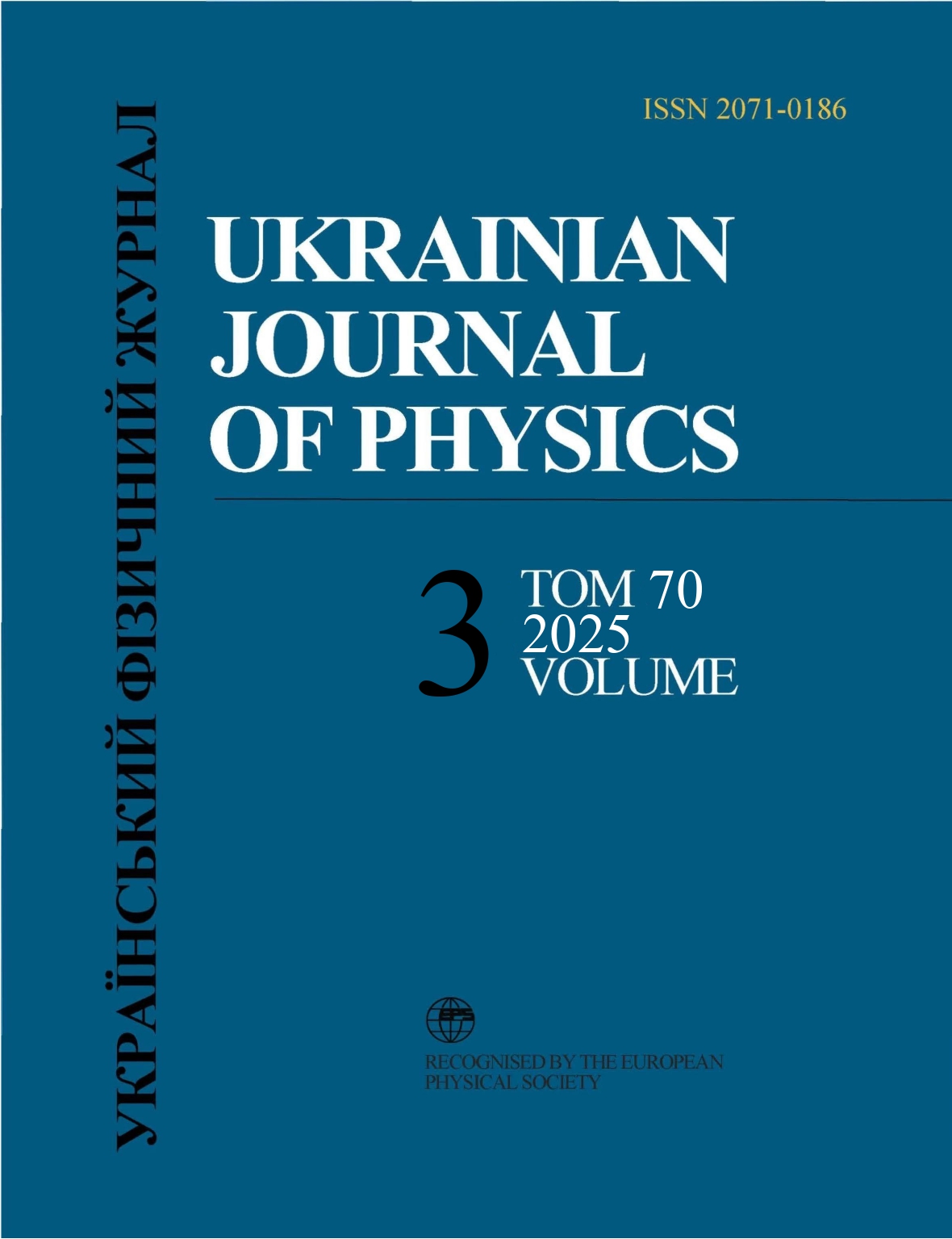
Geometric Measure of Entanglement of Quantum Graph States Prepared with Controlled Phase Shift Operators
DOI:
https://doi.org/10.15407/ujpe70.3.161Keywords:
geometric measure of entanglement, multiqubit graph states, weighted graph, quantum computerAbstract
We will consider graph states generated by the action of controlled phase shift operators on a separable state of a multiqubit system. The case where all the qubits are initially prepared in arbitrary states is investigated. We will obtain the geometric measure of entanglement of a qubit with the remaining system in graph states represented by arbitrary weighted graphs and will establish its relationship with state parameters. For two-qubit graph states, the geometric measure of entanglement is also quantified on IBM’s simulator Qiskit Aer and quantum processor ibmq lima based on auxiliary mean spin measurements. The results of quantum computations verify our analytic predictions.
References
1. C.H. Bennett, G. Brassard, C. Cr'epeau, R. Jozsa, A. Peres, W.K. Wootters. Teleporting an unknown quantum state via dual classical and Einstein-Podolsky-Rosen channels. Phys. Rev. Lett. 70, 1895 (1993).
https://doi.org/10.1103/PhysRevLett.70.1895
2. D. Bouwmeester, J.-W. Pan, K. Mattle, M. Eibl, H. Weinfurter, A. Zeilinger. Experimental quantum teleportation. Nature 390, 575 (1997).
3. A.K. Ekert. Quantum cryptography based on Bell's theorem. Phys. Rev. Lett. 67, 661 (1991).
https://doi.org/10.1103/PhysRevLett.67.661
4. R.P. Feynman. Simulating physics with computers. Int. J. Theor. Phys. 21, 467 (1982).
https://doi.org/10.1007/BF02650179
5. P.W. Shor. Polynomial-Time algorithms for prime factorization and discrete logarithms on a quantum computer. SIAM J. Comp. 26, 1484 (1997).
https://doi.org/10.1137/S0097539795293172
6. A. Montanaro. Quantum algorithms: an overview. npj Quant. Inf. 2, 15023 (2016).
https://doi.org/10.1038/npjqi.2015.23
7. M. Cerezo, A. Arrasmith, R. Babbush, S.C. Benjamin, S. Endo, K. Fujii, J.R. McClean, K. Mitarai, X. Yuan, L. Cincio, P.J. Coles. Variational quantum algorithms. Nat. Rev. Phys. 3, 625 (2021).
https://doi.org/10.1038/s42254-021-00348-9
8. A. Einstein, B. Podolsky, N. Rosen. Can quantummechanical description of physical reality be considered complete? Phys. Rev. 47, 777 (1935).
https://doi.org/10.1103/PhysRev.47.777
9. R. Horodecki, P. Horodecki, M. Horodecki. Quantum entanglement. Rev. Mod. Phys. 81, 865 (2009).
https://doi.org/10.1103/RevModPhys.81.865
10. H.J. Briegel, R. Raussendorf. Persistent entanglement in arrays of interacting particles. Phys. Rev. Lett. 86, 910 (2001).
https://doi.org/10.1103/PhysRevLett.86.910
11. R. Raussendorf, H.J. Briegel. A one-way quantum computer. Phys. Rev. Lett. 86, 5188 (2001).
https://doi.org/10.1103/PhysRevLett.86.5188
12. M. Hein, J. Eisert, H.J. Briegel. Multiparty entanglement in graph states. Phys. Rev. A 69, 062311 (2004).
https://doi.org/10.1103/PhysRevA.69.062311
13. O. G¨uhne, G. T'oth, P. Hyllus, H.J. Briegel. Bell inequalities for graph states. Phys. Rev. Lett. 95, 120405 (2005).
https://doi.org/10.1103/PhysRevLett.95.120405
14. D. Schlingemann, R.F. Werner. Quantum error-correcting codes associated with graphs. Phys. Rev. A 65, 012308 (2001).
https://doi.org/10.1103/PhysRevA.65.012308
15. B.A. Bell, D.A. Herrera-Mart'i, M.S. Tame, D. Markham, W.J. Wadsworth, J.G. Rarity. Experimental demonstration of a graph state quantum error-correction code. Nat. Commun. 5, 3658 (2014).
https://doi.org/10.1038/ncomms4658
16. P. Liao, B.C. Sanders, D.L. Feder. Topological graph states and quantum error-correction codes. Phys. Rev. A 105, 042418 (2022).
https://doi.org/10.1103/PhysRevA.105.042418
17. N. Shettell, D. Markham. Graph states as a resource for quantum metrology. Phys. Rev. Lett. 124, 110502 (2020).
https://doi.org/10.1103/PhysRevLett.124.110502
18. H. Tao, X. Tan. Quantum multiparameter estimation with graph states. arXiv:2306.02518 [quant-ph].
19. X. Gao, Z.-Y. Zhang, L.-M. Duan. A quantum machine learning algorithm based on generative models. Sci. Adv. 4, 12 (2018).
https://doi.org/10.1126/sciadv.aat9004
20. C. Zoufal, A. Lucchi, S. Woerner. Quantum generative adversarial networks for learning and loading random distributions. npj Quant. Inf. 5, 103 (2019).
https://doi.org/10.1038/s41534-019-0223-2
21. Kh.P. Gnatenko. Evaluation of variational quantum states entanglement on a quantum computer by the mean value of spin. arXiv:2301.03885 [quant-ph].
22. Y. Wang, Y. Li, Zq. Yin, B. Zeng. 16-qubit IBM universal quantum computer can be fully entangled. npj Quant. Inf. 4, 46 (2018).
https://doi.org/10.1038/s41534-018-0095-x
23. G.J. Mooney, Ch.D. Hill, L.C.L. Hollenberg. Entanglement in a 20-qubit superconducting quantum computer. Sci. Rep. 9, 13465 (2019).
https://doi.org/10.1038/s41598-019-49805-7
24. Kh.P. Gnatenko, V.M. Tkachuk. Entanglement of graph states of spin system with Ising interaction and its quantifying on IBM's quantum computer. Phys. Lett. A 396, 127248 (2021).
https://doi.org/10.1016/j.physleta.2021.127248
25. A. Vesperini. Correlations and projective measurements in maximally entangled multipartite states. Ann. Phys. 457, 169406 (2023).
https://doi.org/10.1016/j.aop.2023.169406
26. A. Vesperini, R. Franzosi. Entanglement, quantum correlators and connectivity in graph states. Adv. Quantum Technol. 7, 2300264 (2024).
https://doi.org/10.1002/qute.202300264
27. Kh.P. Gnatenko, N.A. Susulovska. Geometric measure of entanglement of multi-qubit graph states and its detection on a quantum computer. EPL 136, 40003 (2022).
https://doi.org/10.1209/0295-5075/ac419b
28. A.R. Kuzmak, V.M. Tkachuk. Detecting entanglement by the mean value of spin on a quantum computer. Phys. Lett. A 384, 126579 (2020).
https://doi.org/10.1016/j.physleta.2020.126579
29. A.R. Kuzmak, V.M. Tkachuk. Preparation and study of the entanglement of the Schr¨odinger cat state on the ibmqmelbourne quantum computer. Condens. Matter Phys. 23, 43001 (2020).
https://doi.org/10.5488/CMP.23.43001
30. A. Shimony. Degree of entanglement. Ann. N.Y. Acad. Sci. 755, 675 (1995).
https://doi.org/10.1111/j.1749-6632.1995.tb39008.x
31. D. Cocchiarella, S. Scali, S. Ribisi, B. Nardi, G. BelHadj-Aissa, R. Franzosi. Entanglement distance for arbitrary M-qudit hybrid systems. Phys. Rev. A 101, 042129 (2020).
https://doi.org/10.1103/PhysRevA.101.042129
32. A.M. Frydryszak, M.I. Samar, V.M. Tkachuk. Quantifying geometric measure of entanglement by mean value of spin and spin correlations with application to physical systems. Eur. Phys. J. D 71, 233 (2017).
https://doi.org/10.1140/epjd/e2017-70752-3
33. R.N. Deb. Von Neumann entropy in a dispersive cavity. J. Mod. Opt. 68, 19 (2021).
https://doi.org/10.1080/09500340.2021.1970306
34. IBM Q experience. https://quantum-computing.ibm.com/.
Downloads
Published
Issue
Section
License
Copyright Agreement
License to Publish the Paper
Kyiv, Ukraine
The corresponding author and the co-authors (hereon referred to as the Author(s)) of the paper being submitted to the Ukrainian Journal of Physics (hereon referred to as the Paper) from one side and the Bogolyubov Institute for Theoretical Physics, National Academy of Sciences of Ukraine, represented by its Director (hereon referred to as the Publisher) from the other side have come to the following Agreement:
1. Subject of the Agreement.
The Author(s) grant(s) the Publisher the free non-exclusive right to use the Paper (of scientific, technical, or any other content) according to the terms and conditions defined by this Agreement.
2. The ways of using the Paper.
2.1. The Author(s) grant(s) the Publisher the right to use the Paper as follows.
2.1.1. To publish the Paper in the Ukrainian Journal of Physics (hereon referred to as the Journal) in original language and translated into English (the copy of the Paper approved by the Author(s) and the Publisher and accepted for publication is a constitutive part of this License Agreement).
2.1.2. To edit, adapt, and correct the Paper by approval of the Author(s).
2.1.3. To translate the Paper in the case when the Paper is written in a language different from that adopted in the Journal.
2.2. If the Author(s) has(ve) an intent to use the Paper in any other way, e.g., to publish the translated version of the Paper (except for the case defined by Section 2.1.3 of this Agreement), to post the full Paper or any its part on the web, to publish the Paper in any other editions, to include the Paper or any its part in other collections, anthologies, encyclopaedias, etc., the Author(s) should get a written permission from the Publisher.
3. License territory.
The Author(s) grant(s) the Publisher the right to use the Paper as regulated by sections 2.1.1–2.1.3 of this Agreement on the territory of Ukraine and to distribute the Paper as indispensable part of the Journal on the territory of Ukraine and other countries by means of subscription, sales, and free transfer to a third party.
4. Duration.
4.1. This Agreement is valid starting from the date of signature and acts for the entire period of the existence of the Journal.
5. Loyalty.
5.1. The Author(s) warrant(s) the Publisher that:
– he/she is the true author (co-author) of the Paper;
– copyright on the Paper was not transferred to any other party;
– the Paper has never been published before and will not be published in any other media before it is published by the Publisher (see also section 2.2);
– the Author(s) do(es) not violate any intellectual property right of other parties. If the Paper includes some materials of other parties, except for citations whose length is regulated by the scientific, informational, or critical character of the Paper, the use of such materials is in compliance with the regulations of the international law and the law of Ukraine.
6. Requisites and signatures of the Parties.
Publisher: Bogolyubov Institute for Theoretical Physics, National Academy of Sciences of Ukraine.
Address: Ukraine, Kyiv, Metrolohichna Str. 14-b.
Author: Electronic signature on behalf and with endorsement of all co-authors.

.png)