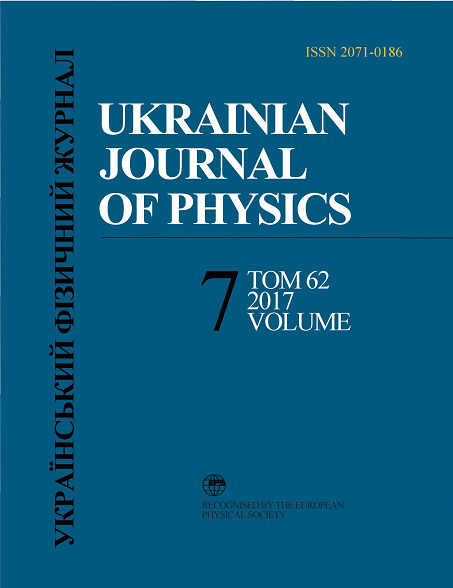
Composite Scintillators and Some Features of Their Radiation Resistance
DOI:
https://doi.org/10.15407/ujpe62.07.0569Keywords:
composite scintillators, radiation resistanceAbstract
Nowadays, composite scintillators find applications in a growing number of tasks dealing with the detection of ionizing radiation. They have several advantages in comparison with other scintillation materials. With the emergence of a new generation of accelerators, the radiation load on detectors is significantly increased. Therefore, the development of materials with high radiation resistance for radiation detectors becomes an important task. We propose to apply composite scintillators as radiation-resistant materials. The most important factor is that irradiation can significantly modify the characteristics of a scintillation material. The aim of this work was to study the specific features of possible radiation-induced damages and transformations in composite scintillators under the action of ionizing radiation. A comparative analysis of the relative light yield, transmittance, and luminescence spectra, as well as their dependences on the accumulated dose, is carried out for various composite scintillators containing grains of organic or inorganic single crystals, such as Gd2SiO5:Ce, Gd2Si2O7:Ce, Al2O3 :Ti, Y2SiO5:Ce, and Y3Al5O12:Ce. Probable mechanisms of radiation-induced changes occurring in scintillators under irradiation are proposed, and the influence of those processes on the radiation resistance of composite scintillators is analyzed.
References
N.Z. Galunov. New generation of high effective organic scintillators and their process technology. In Transactions of International Technology Transfer Conference (Iowa State University, USA, 1998), p. 124.
S.V. Budakovsky, N.Z. Galunov, V.P. Seminozhenko. Some new approaches to obtain the organic crystals with high quality. In Book of Lecture Notes of First Interna580 tional School on Crystal Growth Technology (Beatenberg, Switzerland, 1998), p. 777.
N.Z. Galunov, J.H. Baker, S.V. Budakovsky, O.A. Tarasenko, A.Yu. Rybalko, V.V. Yarychkin. Organic polycrystals as the new luminescent system for scintillation and ecology techniques. J. Luminesc. 102, 464 (2003).
https://doi.org/10.1016/S0022-2313(02)00579-3
S.V. Budakovsky, N.Z. Galunov, B.V. Grinyov, N.L. Karavaeva, J.K. Kim, Y.K. Kim, N.V. Pogorelova, O.A. Tarasenko. Stilbene crystalline powder in polymer base as the new fast neutron detector. Radiat. Meas. 42, 565 (2007).
https://doi.org/10.1016/j.radmeas.2007.02.058
S.V. Budakovsky, N.Z. Galunov, N.L. Karavaeva, J.K. Kim, Y.K. Kim, O.A. Tarasenko, E.V. Martynenko. New effective organic scintillators for fast neutron and short-range radiation detection. IEEE Trans. Nucl. Sci. 54, 2734 (2007).
https://doi.org/10.1109/TNS.2007.910423
N.L. Karavaeva, S.V. Budakovskyi, M.Z. Galunov. Scintillation detector on the basis of organic scintillator. Patent 86136 Ukraine, IPC 51 G01T 1/20, G01T 3/00. No. a200708433; appl. 23.07.07; publ. 25.03.2009, Bull. No. 6 (in Ukrainian).
N.Z. Galunov, B.V. Grinyov, N.L. Karavaeva, J.K. Kim, Y.K. Kim, O.A. Tarasenko, E.V. Martynenko. Development of new composite scintillation materials based on organic crystalline grains. IEEE Trans. Nucl. Sci. 56, 904 (2009).
https://doi.org/10.1109/TNS.2009.2015761
N.Z. Galunov, B.V. Grinyov, N.L. Karavaeva, Ya.V. Gerasymov, O.Ts. Sidletskiy, O.A. Tarasenko. Gd-bearing composite scintillators as the new thermal neutron detectors. IEEE Trans. Nucl. Sci. 58, 339 (2011).
https://doi.org/10.1109/TNS.2010.2096516
S.K. Lee, Y.H. Cho, B.H. Kang, W.G. Lee, J.K. Kim, D.G. Kim, N.Z. Galunov, Y.K. Kim. Scintillation properties of composite stilbene crystal for neutron detection. Prog. Nucl. Sci. Technol. 1, 292 (2011).
https://doi.org/10.15669/pnst.1.292
J. Iwanowska, L. Swiderski, M. Moszynski, T. Szczesniak, P. Sibczynski, N.Z. Galunov, N.L. Karavaeva. Neutron/gamma discrimination properties of composite scintillation detectors. J. Instrument. 6, 1 (2011).
https://doi.org/10.1088/1748-0221/6/07/P07007
N.L. Karavaeva, O.A. Tarasenko, M.Z. Galunov, Ya.V. Gerasymov. Compositional Scintillator, Patent 94678 Ukraine, IPC51 G01T 1/20, G01T 3/00. No. a201007067; appl. 07.06.10; publ. 25.05.2011, Bull. No. 10 (in Ukrainian).
S.K. Lee, J.B. Son, K.H. Jo, B.H. Kang, G.D. Kim, H. Seo, S.H. Park, N.Z. Galunov, Y.K. Kim. Development of largearea composite stilbene scintillator for fast neutron detection, J. Nucl. Sci. Technol. 51, 37 (2014).
https://doi.org/10.1080/00223131.2014.845539
N.Z. Galunov, N.L. Karavaeva, A.V. Krech, I.V. Lazarev, L.G. Levchuk, V.O. Mikhailenko, V.F. Popov, P.V. Sorokin. Peculiarities of radiation resistance of organic scintillators. In Abstracts of the 13th Conference on High Energy Physics, Nuclear Physics and Accelerators (March 16–20, 2015), p. 99 (in Russian).
CMS Collaboration. Technical proposal for the upgrade of the CMS detector through 2020, CERN-LHCC-2011-006, CMS-UG-TP-1, LHCC-P-004 (CERN, Geneva, 2011).
J.B. Birks. The Theory and Practice of Scintillation Counting (Pergamon Press, 1967).
A. Quaranta, S. Carturan, T. Marchi et al. Radiation hardness of polysiloxane rubbers. Nucl. Instrum. Methods B 268, 3155 (2010).
https://doi.org/10.1016/j.nimb.2010.05.077
A.Yu. Boyarintsev, N.Z. Galunov, N.L. Karavaeva, A.V. Krech, I.V. Lazarev, L.G. Levchuk, T.A. Nepokupnaya, V.D. Panikarskaya, V.F. Popov, P.V. Sorokin, O.A. Tarasenko. Study of radiation-resistant gel bases for composite detectors. Funct. Mater. 20, 471 (2013).
https://doi.org/10.15407/fm20.04.471
N.L. Karavaeva, Composite scintillators as new type of a scintillation material. Probl. At. Sci. Technol. Ser. Nucl. Phys. Invest. N 1, 91 (2014).
E. Biagtan, E. Goldberg, J. Harmon, R. Stephens. Effect of gamma radiation dose rate on the light output of commercial polymer scintillators, Nucl. Instrum. Methods B 93, 296 (1994).
https://doi.org/10.1016/0168-583X(94)95478-X
N.L. Karavaeva, N.Z. Galunov, E.V. Martynenko, A.V. Kosinova. Combined composite scintillation detector for separate measurements of fast and thermal neutrons, Funct. Mater. 17, 549 (2010).
M. Tanaka, K. Haraa, S. Kim, K. Kondo et al. Applications of cerium-doped gadolinium silicate Gd2SiO5:Ce scintillator to calorimeters in high-radiation environment. Nucl. Instrum. Methods A 404, 283 (1998).
https://doi.org/10.1016/S0168-9002(97)01142-X
A.Yu. Boyarintsev, N.Z. Galunov, Ia.V. Gerasymov, N.L. Karavaeva, A.V. Krech, L.G. Levchuk, V.F. Popov, O.Ts. Sidletskiy, P.V. Sorokin, O.A. Tarasenko. Radiationresistant composite scintillators based on GSO and GPS grains, Nucl. Instrum. Methods A 841, 124 (2017).
https://doi.org/10.1016/j.nima.2016.10.034
A.Yu. Boyarintsev, N.Z. Galunov, Ia.V. Gerasymov, T.E. Gorbacheva, N.L. Karavaeva, A.V. Krech, L.G. Levchuk, L.A. Litvinov, V.F. Popov, O.Ts. Sidletskiy, P.V. Sorokin, O.A. Tarasenko. Radiation-resistant composite scintillators based on inorganic crystals (GSO:Ce, GPS:Ce and Al2O3 : Ti). Probl. At. Sci. Technol. Ser. Nucl. Phys. Invest. 105, No. 5, 59 (2016).
R.C. Powell, Z. Alshaieb, J.M. Bowen, J.L. Caslavsky. Growth, characterization, and optical spectroscopy of Al2O3 : Ti(3+). J. Appl. Phys. 58, 2331 (1985).
https://doi.org/10.1063/1.335955
P. Lacovara, L. Esterowitz, M. Kokta. Growth, spectroscopy, and lasing of titanium-doped sapphire, IEEE J. Quant. Electr. QE-21, 1614 (1985).
https://doi.org/10.1109/JQE.1985.1072563
A. Lupei, V. Lupei, C. Lonescu, H.G. Tang, M.L. Chen, Spectroscopy of Ti3+ : -Al2O3. Opt. Commun. 59, 36 (1986).
https://doi.org/10.1016/0030-4018(86)90041-6
R.C. Powell, G.E. Venikouas, Lin Xi, J.K. Tyminski, M.R. Kokta. Thermal effects on the optical spectra of Al2O3 : Ti3+. J. Chem. Phys. 84, 662 (1986).
https://doi.org/10.1063/1.450561
G. Blasse, J.W.M. Verweij. The luminescence of titanium in sapphire laser material. Mater. Chem. Phys. 26, 131 (1990).
https://doi.org/10.1016/0254-0584(90)90033-7
L.E. Bausa, I. Vergara, F. Jaque, J. Garcia-Sole. Ultraviolet laser excited luminescence of Ti-sapphire. J. Phys.: Condens.Matter 2, 9919 (1990).
https://doi.org/10.1088/0953-8984/2/49/016
B. Macalik, L.E. Bausa, J. Garcia-Sole, F. Jaque, J.E. Munoz Santiuste, I. Vergara. Blue emission in Ti-sapphire laser crystals, Appl. Phys. A 55, 144 (1992).
https://doi.org/10.1007/BF00334213
M. Globus, B. Grinyov, J.K. Kim, Inorganic Scintillators for Modern and Traditional Applications (Institute for Single Crystals of the NASU, 2005).
V.B. Mikhailik, H. Kraus, M. Balcerzyk, W. Czarnacki, M. Moszynski, M.S. Mykhaylyk, D. Wahl. Low-temperature spectroscopic and scintillation characterisation of Tidoped Al2O3. Nucl. Instrum. Methods A 546, 523 (2005).
https://doi.org/10.1016/j.nima.2005.02.033
M. Luca, N. Coron, C. Dujardin, H. Kraus, V.B. Mikhailik, M.A. Verdier, P.C.F. Di Stefano. Scintillation and optical spectroscopy of Al2O3:Ti for dark matter searching. Nucl. Instrum. Methods A 606, 545 (2009).
https://doi.org/10.1016/j.nima.2009.04.034
H.H. Kusuma, Z. Ibrahim. UV-Spectroscopy and band structure of Ti:Al2O3. Solid State Sci. Technol. 20, 41 (2012).
C.L. Melcher, J.S. Schweitzer, C.A. Peterson, R.A. Manente, H. Suzuki. Crystal growth and scintillation properties of the rare earth orthosilicates. In Inorganic Scintillators and Their Applications (Delft Univ. Press, 1996), p. 309.
E. Mihokova, M. Nikl, J.A. Mares, A. Beitlerova, A. Vedda, K. Nejezchleb, K. Blazek, C. D'Ambrosio. Luminescence and scintillation properties of YAG : Ce single crystal and optical ceramics, J. Luminesc. 126, 77 (2007).
https://doi.org/10.1016/j.jlumin.2006.05.004
N.Z. Galunov, Ya.V. Gerasimov, T.E. Gorbacheva, B.V. Grinev, N.L. Karavaeva, A.V. Krech, L.G. Levchuk, E.V. Martynenko, V.F. Popov, O.Ts. Sidletskii, P.V. Sorokin, O.A. Tarasenko, S.U. Khabuseva. Composite scintillators on the basis of inorganic grains (Y2SiO5 : Ce and Y3Al5O12 : Ce). In Abstracts of the 15th Conference on High Energy Physics, Nuclear Physics and Accelerators (Kharkiv, March 21–24, 2017), p. 22 (in Russian).
Downloads
Published
Issue
Section
License
Copyright Agreement
License to Publish the Paper
Kyiv, Ukraine
The corresponding author and the co-authors (hereon referred to as the Author(s)) of the paper being submitted to the Ukrainian Journal of Physics (hereon referred to as the Paper) from one side and the Bogolyubov Institute for Theoretical Physics, National Academy of Sciences of Ukraine, represented by its Director (hereon referred to as the Publisher) from the other side have come to the following Agreement:
1. Subject of the Agreement.
The Author(s) grant(s) the Publisher the free non-exclusive right to use the Paper (of scientific, technical, or any other content) according to the terms and conditions defined by this Agreement.
2. The ways of using the Paper.
2.1. The Author(s) grant(s) the Publisher the right to use the Paper as follows.
2.1.1. To publish the Paper in the Ukrainian Journal of Physics (hereon referred to as the Journal) in original language and translated into English (the copy of the Paper approved by the Author(s) and the Publisher and accepted for publication is a constitutive part of this License Agreement).
2.1.2. To edit, adapt, and correct the Paper by approval of the Author(s).
2.1.3. To translate the Paper in the case when the Paper is written in a language different from that adopted in the Journal.
2.2. If the Author(s) has(ve) an intent to use the Paper in any other way, e.g., to publish the translated version of the Paper (except for the case defined by Section 2.1.3 of this Agreement), to post the full Paper or any its part on the web, to publish the Paper in any other editions, to include the Paper or any its part in other collections, anthologies, encyclopaedias, etc., the Author(s) should get a written permission from the Publisher.
3. License territory.
The Author(s) grant(s) the Publisher the right to use the Paper as regulated by sections 2.1.1–2.1.3 of this Agreement on the territory of Ukraine and to distribute the Paper as indispensable part of the Journal on the territory of Ukraine and other countries by means of subscription, sales, and free transfer to a third party.
4. Duration.
4.1. This Agreement is valid starting from the date of signature and acts for the entire period of the existence of the Journal.
5. Loyalty.
5.1. The Author(s) warrant(s) the Publisher that:
– he/she is the true author (co-author) of the Paper;
– copyright on the Paper was not transferred to any other party;
– the Paper has never been published before and will not be published in any other media before it is published by the Publisher (see also section 2.2);
– the Author(s) do(es) not violate any intellectual property right of other parties. If the Paper includes some materials of other parties, except for citations whose length is regulated by the scientific, informational, or critical character of the Paper, the use of such materials is in compliance with the regulations of the international law and the law of Ukraine.
6. Requisites and signatures of the Parties.
Publisher: Bogolyubov Institute for Theoretical Physics, National Academy of Sciences of Ukraine.
Address: Ukraine, Kyiv, Metrolohichna Str. 14-b.
Author: Electronic signature on behalf and with endorsement of all co-authors.

.png)